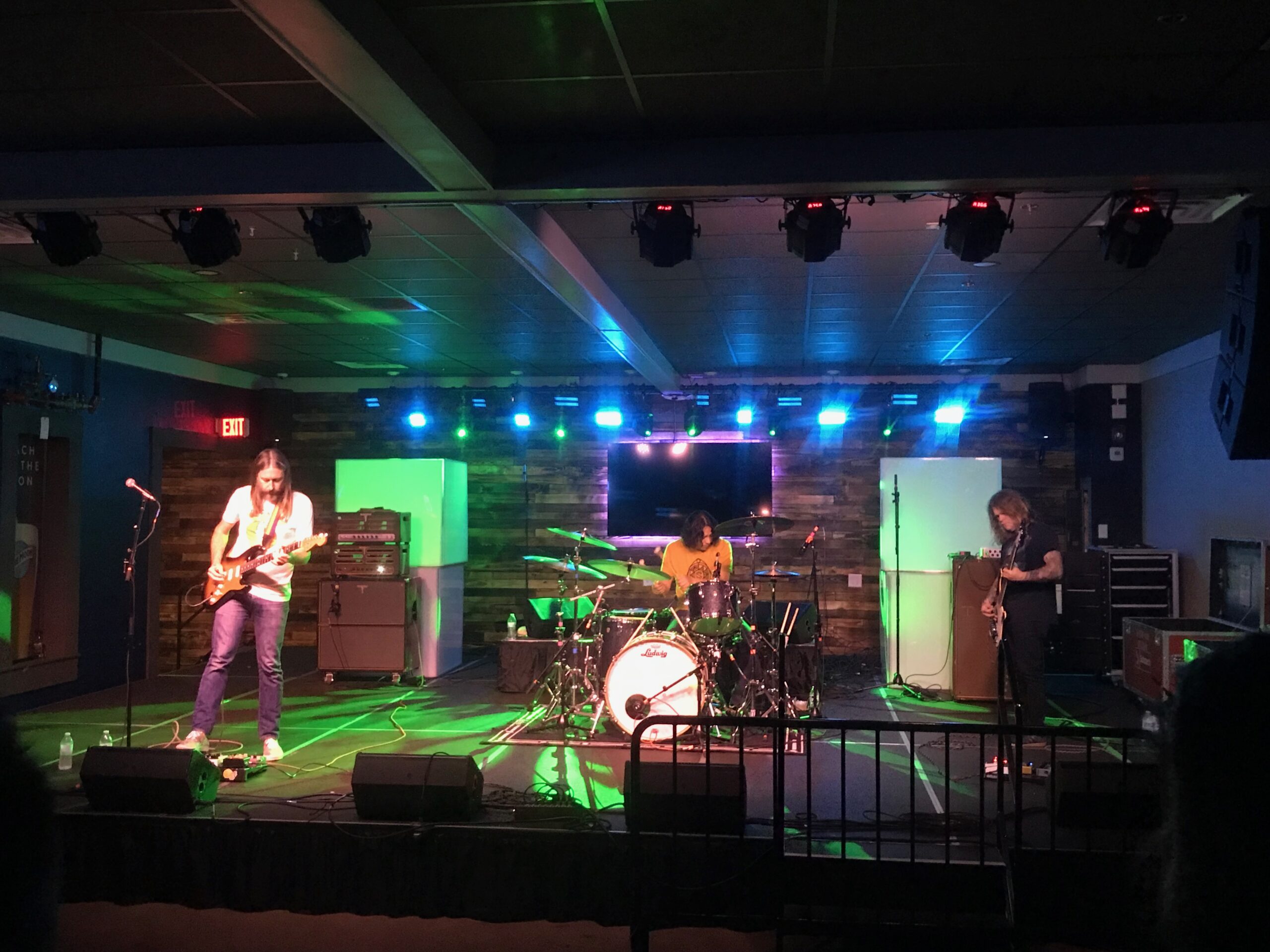
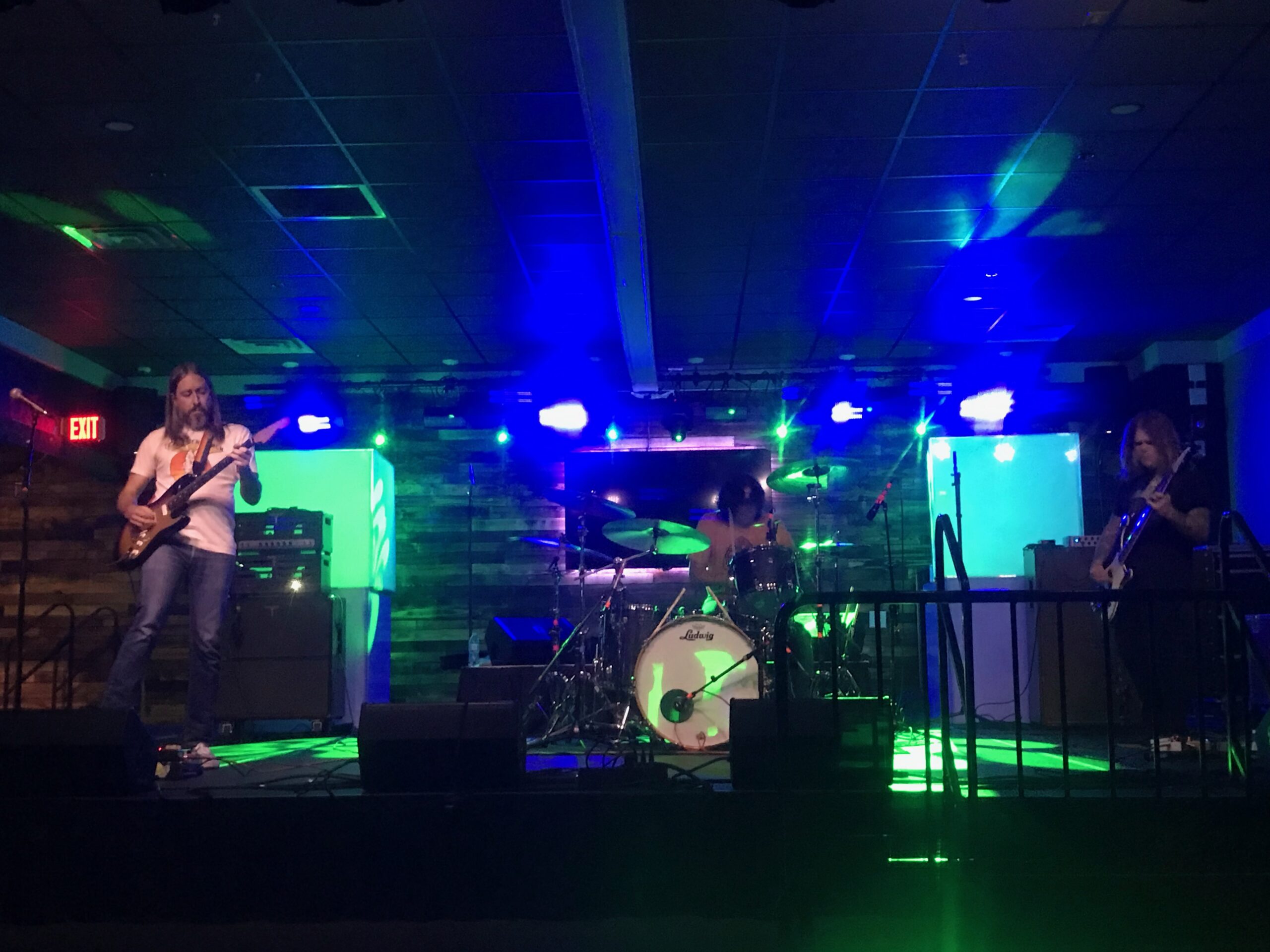
It was the end of the first leg of Earthless‘ U.S. tour, and it turned out to be guitarist Isaiah Mitchell‘s birthday. It also turned out to be another stunning performance by them.
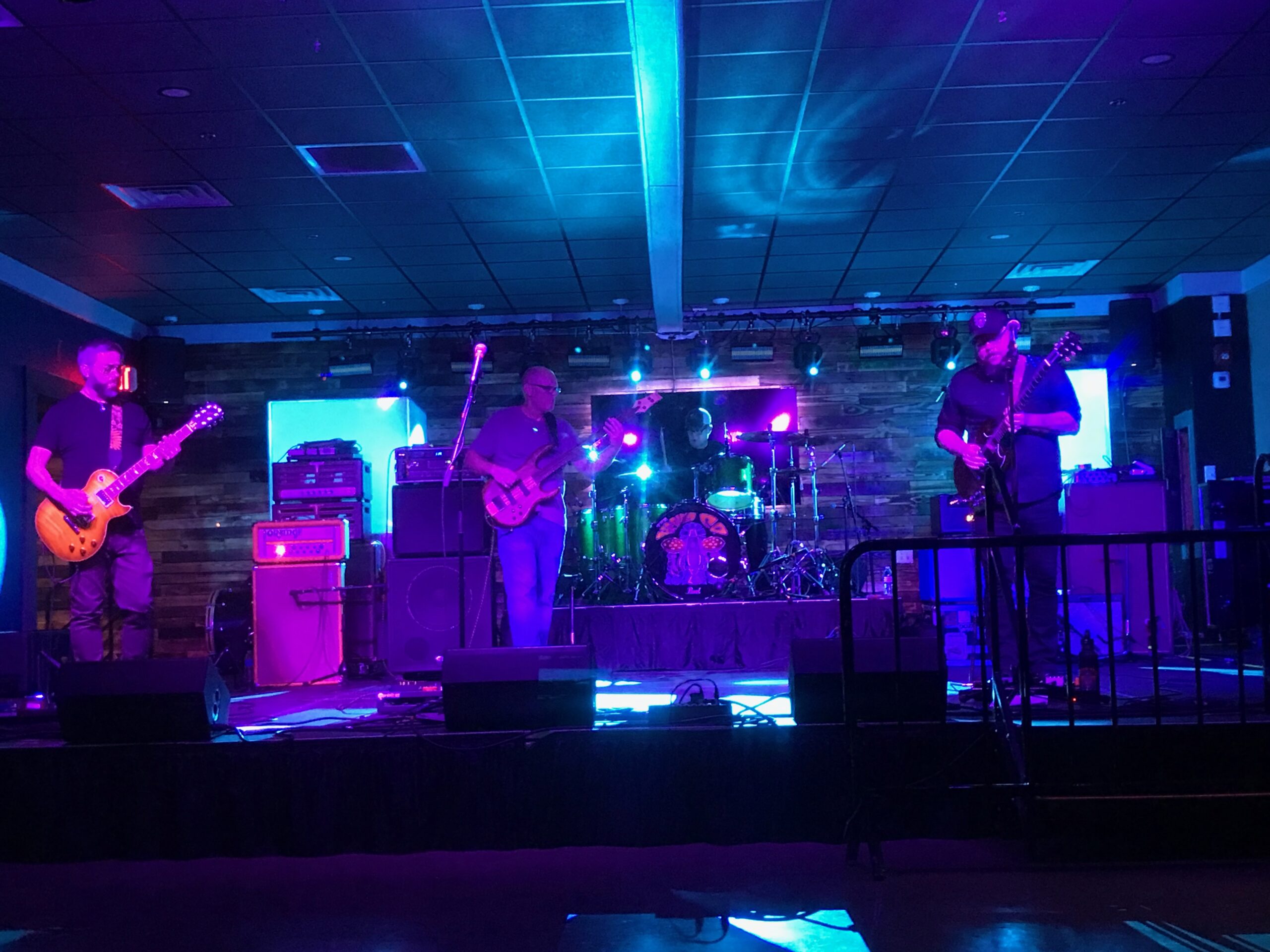
My friend and I go to the venue too late to see the first opening band, Ancient Days, but we did catch The Heavy Company (otherwise known as THC) play a blues-infused rock set that impressed the enthusiastic crowd.
The Heavy Company
Earthless played for a little over an hour, and that set was three songs. If you’re new to Earthless, you need to know that two of those songs were over twenty minutes long, and the third was nearly fifteen minutes long. They don’t skimp anything during a show. They give all every time. I yelled, “I can’t feel my face.” after the end of the second track.
L-R: Isaiah Mitchell, Mario Rubalcaba, Mike Eginton
It’s difficult to describe how much heavy power they unleash. I was reminded during their performance of an analogy my wife heard once about a full jar. Take a large, earthenware jar and fill it with rocks. Is the jar full? No. It may seem like it is, but you could fill the space between the rocks with water. Full now? No, because you could slowly add sand to the jar to absorb the water and take up all the remaining space. Now the jar is so heavy you’d need Hulk-like strength to lift it.
Now change the venue to a music venue that holds about 200 people and change the rocks to Isaiah Mitchell’s bass riffs, the water to Mario Rubalcaba’s drum fills, and the sand to Mike Eginton’s heavy bass riffs and you’ll get the idea.
Out now from Third Man Books, Monolithic Undertowalights a crooked path across musical, religious and subcultural frontiers. It traces the line from ancient traditions to the modern underground, navigating archaeoacoustics, ringing feedback, chest plate sub-bass, avant-garde eccentricity, sound weaponry and fervent spiritualism.
From Neolithic beginnings to bawdy medieval troubadours, Sufi mystics to Indian raga masters, cone-shattering dubwise bass, Hawkwind‘s Ladbroke Grove to the outer reaches of Faust and Ash Ra Temple; the hash-fueled fug of The Theatre of Eternal Music to the cough syrup reverse hardcore of Melvins, seedy VHS hinterland of Electric Wizard, ritual amp worship of Earth and Sunn O))) and the many touch points in between, Monolithic Undertow explores the power of the drone – an audio carrier vessel capable of evoking womb like warmth or cavernous dread alike.
In 1977, Sniffin’ Glue verbalized the musical zeitgeist with their infamous ‘this is a chord; this is another; now form a band’ illustration. The drone requires neither chord nor band, representing – via its infinite pliability and accessibility – the ultimate folk music: a potent audio tool of personal liberation.
Immersion in hypnotic and repetitive sounds allows us to step outside of ourselves, be it chant, a 120dB beasting from Sunn O))), standing front of the system as Jah Shaka drops a fresh dub or going full headphone immersion with Hawkwind. These experiences are akin to an audio portal – a sound Tardis to silence the hum and fizz of the unceasing inner voice. The drone exists outside of us, but also – paradoxically – within us all; an aural expression of a universal hum we can only hope to fleetingly channel…
Monolithic Undertow: In Search of Sonic Oblivion is out now and is available for purchase here. The North American edition of the book features an exclusive cover and a new foreword by author Harry Sword.
Distributed Exclusively in North America by Consortium Books/Ingram Content Group.
Third Man Books | 05.17.2022 | 341 Pages Paperback | $19.95 | ISBN: 9781737382935 | 6”x 8” | B/W Photos | Music History
Recorded in 2019, Live at Freak Valleyby King Buffalo is a well-mastered and engineered document of a powerful set at that year’s Freak Valley Festival. It’s a great introduction to King Buffalo’s live sound if you’ve never heard it before and will make you want to seek them out at the nearest venue as soon as possible.
“Sun Shivers” sets off the show by launching us away from Earth’s gravity and into the endless sea of stars leading to the sun and beyond. They waste no time and get right to the cosmic riffs. “Longing to Be the Mountain” is a reference to a Chinese story about a stonecutter working on a mountain who desires to become the grand mountain that seems to be above all people, things, and concerns. He’s granted his wish but soon feels a tapping at his base. He looks down to see another stonecutter there chipping away at him. The stonecutter was caught by his own ego and delusions The song is a powerful as the lesson.
“Every day is the same,” they sing on “Repeater,” a fourteen-minute mind-melting experience that covers both existential ennui and Zen presence. By the time you get to “Orion” (“Can you hear me through the smoke and the haze?”), it feels like you’re drifting past his belt of stars. It’s a stunning track that must’ve been quite an experience for the lucky Freak Valley attendees.
“Kerosene” twists and turns around itself like some kind of heavy metal Escher drawing. They mention that A Place to Bury Strangers is up after them (which you can see here) before they get to the closer, “Eye of the Storm.” It’s a great closer that bridges the gap between stoner rock and desert rock for over ten glorious minutes. They encourage us to embrace the void without fear, for the eye of the storm is often the safest place.
If you’re looking for a good way to start off your trippy, heavy space rock record, why not do it with a song called “Blast Off?” That’s what Psychlona does on their cool Venus Skytripalbum.
The opening track builds with guitar notes sounding like a countdown clock that blend into actual rocket launch countdown recordings and rocket fuel-hot riffs and drum hits. The band’s love of Black Sabbathis evident from the opening riffs of “10,000 Volts,” which hits as hard as its namesake one moment and lulls you into a dreamy headspace the next as they sing about voices in their heads confusing their souls. “Blow” adds stadium rock riffs to the mix.
“Star” punches the accelerator the band’s starship to the floor and plunges us straight toward a red dwarf about to go nova. “Edge of the Universe” practically takes you there. You can probably guess the inspiration behind “Resin,” and it’s as trippy as you hope it will be. The reverb-laden vocals, the echoing guitars, and the cool yet heavy drums all combine to make a satisfying blend.
“Tijuana” seems to be a story about the band encountering dangerous women, dangerous drinks, and other dangerous substances and people while on a trip south of the U.S. border. The whole thing sizzles like an annoyed rattlesnake on a hot rock. The album closes with “The Owl,” a grand, thundering piece that casts a bird of prey’s shadow over you and almost makes you quiver like a mouse in an open field.
This is a cool record, and I hope Psychlona gets us more new music soon. I’d happily go on another sky trip with them. How about Saturn next time, lads?
Keep your mind open.
[Blast over to the subscription box while you’re here.]
Los Angeles based unsung guitar hero Randy Holden announces the sequel to his legendary 1970 album Population II, set to arrive 52 years later, titled Population III via RidingEasy Records. The ex-Blue Cheer guitarist’s new album was recorded as a trio with members of Cactus and Black Sabbath. Hear and share the first single “Swamp Stomp” via Brooklyn Vegan HERE. (And direct via Bandcamp and YouTube.) How do you follow up one of the most legendary, yet rarest albums said to signal the birth of doom metal?
If you’re Randy Holden, you give everyone about 50 years to catch up, then casually drop a tastefully modernized reinterpretation of that sound. Population III picks up where Holden’s 1969 solo debut left off, updated with several decades worth of technological advances and personal hindsight.
Following his tenure in proto-metal pioneers Blue Cheer in 1969, the guitarist aimed for more control over his next project. Thus, Randy Holden – Population II was born, the duo naming itself after the astronomical term for a particular star cluster with heavy metals present. Along with drummer/keyboardist Chris Lockheed, Holden created what many say is one of the earliest forms of doom metal.
“Godzilla just walked into the room. People just stood there with their eyes and mouths wide open,” Holden says of the audience’s reaction to their live debut performing with a teeth-rattling phalanx of 16 (sixteen!) 200 watt Sunn amps. Likewise, their 6-song debut album Population II delves into leaden sludge, lumbering doom and epic soaring riffs that sound free from all constraints of the era. It’s incredibly heavy, but infused with a melodic, albeit mechanistic sensibility. However, troubles with the album’s original 1970 release bankrupted Holden, who subsequently left music for over two decades. For good reason, it’s widely hailed as a masterpiece, and until finally getting a proper formal release in 2020 on RidingEasy Records, was a longtime Holy Grail for record collectors.
Flash forward 40 years to 2010, we find the guitarist/vocalist quietly coaxed into recording a followup album by Holden superfan and Cactus member Randy Pratt. Joined by drummer Bobby Rondinelli (who has played with Black Sabbath, Blue Öyster Cult, Rainbow), the trio cut the 6-song collection of leaden future blues, Population III. “Randy Pratt had written the basic song structures, he understood my music and where I come from quite well,” Holden says. “He nailed it.”
But the recording was ultimately shelved for over a decade. “A year ago, in 2021 I listened to the songs and was delightfully surprised,” Holden says. “I think it’s the best album I’ve ever done.”
Throughout Population III, Holden effortlessly dishes out squealing, soaring leads and skull-thwacking riffs with his signature low end grit and penchant for Middle Eastern scales. Coupled with Pratt’s pocket-locked bass, the slight flanging effect on Rondinelli’s drums and his pugilistic beats, the album occasionally brings to mind Presence-era Led Zeppelin, particularly on the 22-minute epic “Land of The Sun.” Elsewhere, “Swamp Stomp” echoes more the troglodyte blues of Holden’s older work, with his evermore searing solos showing hints of early Clapton/Hendrix era guitar prowess to drive home the stomp of the song’s namesake. At times, Holden sounds reminiscent of Neil Young leading Crazy Horse’s ruptured grunge as his lilting falsetto vocals push and pull his guitar’s siren’s call. Taken as a whole, there’s a very distinct difference between the way these veterans of hard rock’s formative years carry the songs compared to the more lugubrious riffing of today’s young doom purveyors. Population III is the real deal — a powerful continuation of a sound forged 50 years ago, that almost didn’t happen. Somehow, Randy Holden’s music always finds a way to stand the tests of time.
Population III will be available on LP, CD and download on July 1st, 2022 via RidingEasy Records. Pre-orders are available at ridingeasyrecs.com
This is a haunting live album from the lead singer of The Black Angels, and a performance of Maas’ first solo album – Luca. His backing band is top-notch and it’s like listening to a dream.
Chock-full of post-punk bangers and piercing lyrics about life during and after the pandemic that hit harder now than all of last year, Parquet Courts’ Sympathy for Life is one of those records that reveals more of itself with each listen.
I’m so glad I heard these guys on BBC 6 Music and tracked down Uppers, because I knew it was going to be one of my favorite records of 2021 within thirty seconds on the opening track. Fun lyrics, ripping riffs, and killer beats make it a go-to record for high energy.
A live recording that sounds good enough to be a studio album, Stöner’s Live in the Mojave Desert session is like having a desert rock concert in your house. Play at maximum volume.
One of the smoothest and grooviest records of 2021 came from these guys who embraced their love of disco and mixed it with their reverence for soul. There isn’t a weak track on the whole album.
These are my top five shows of 2021. I hope to see more than 30 bands in 2022, but the future is now – so let’s get to it.
#5: Ty Segall – Psycho Music Festival – August 20th
Playing on a stage atop a wave pool, Ty Segall and his band put on one of the loudest, fiercest sets of the 2021 Psycho Music Festival. The power coming across the water was stunning.
Clutch are always a top tier live band, and this show kept their reputation intact. They played a few new cuts and a lot of stuff from early in their catalogue they hadn’t played in a long while.
I’m not sure I saw a more delighted crowd at any show in 2021. Everyone stopped caring about the heat and humidity, the overpriced food, and the terrible screamo bands on the lineup and started cheering, dancing, and singing.
This set stunned everyone at the Mandalay House of Blues. It was my first time seeing FATW live, and the first time many in the crowd had heard them. It was their first gig in two years, and they came out gunning. I heard someone in another crowd later raving about them and telling everyone he could to listen to them. I can’t put it better than that.
Holy crap. Osees closed the 2021 Psycho Music Festival’s outdoor stage on the last night of the four-night festival. They went bonkers. Yes, I know every Osees show is bonkers, but you could tell they had a lot of pent-up energy from not being able to play in front of a crowd for two years. People were charging through the wading pool in front of the stage, throwing beer buckets full of water on each other, or stumbling backwards on the beach as the wall of sound hit us like a bulldozer.
Everyone stay healthy in 2022 so we can see more shows.
Live shows made a comeback in 2021, thank heavens, but many were still canceled or postponed due to the ongoing pandemic. As a result, I only saw 35 live bands this year. Cutting that list in half (or thereabouts) to save time, here’s the start of my top fifteen concerts of 2021.
#15: Acid Dad – Ft. Wayne, Indiana’s Brass Rail – October 08th
I’d only heard a couple tracks by Acid Dad before seeing them live, and they didn’t fail to impress everyone at the Brass Rail. It was a rocking show of groovy psych-rock with hints of surf and garage rock.
This was the first time I’d seen Protomartyr live as well, and it was a fine show indeed with a ton of great post-punk rock in front of an excited crowd of fellow Michiganders.
#13: Stöner – Ft. Wayne, Indiana’s Piere’s – September 29th
This was two firsts in one, both seeing and hearing Stöner for the first time. They played a cool heavy set of desert rock and won over a lot of fans (including yours truly) at this show. Their shirts and LPs were flying off their merch table after their set.
#12: King Buffalo – Ft. Wayne, Indiana’s Piere’s – September 29th
Yes, the same show. King Buffalo were the first of three bands that night (the third being Clutch). I’d heard of King Buffalo before, but only a couple songs. They played an excellent set of psychedelic rock that set the table for the rest of the night.
#11: All Them Witches – Chicago’s Metro – December 16th
This was the last show I saw in 2021, and ATW put on a solid set of heavy psychedelia. It was the last show of their tour before a break until they played a series of shows around New Year’s Eve.
Who’s in the top ten? Come back tomorrow to learn!
No, this isn’t the fourth Live in the Mojave Desertalbum power rock trio Stöner has released, but it is the fourth in a collection of live performances captured by the Heavy Psych Records label…and, boy, is this thing heavy.
Essentially a live performance of Stöner’s debut album, Stoners Rule (with a different track order), Live in the Mojave Desert absolutely slams from beginning to end. The album opens with cauldron-boiling guitar from lead vocalist Brant Bjork on “Rad Stays Rad” as he sings about the hard job of staying groovy in un-groovy times. Nick Oliveri‘s thundering bass soon joins him, and Ryan Gut slaps his snare like it ate his lunch and left the empty containers in the office refrigerator for him to find later “Nothin'” is a classic muscle car rocker about standing up for what’s yours.
“Own Yer Blues” is blues-influenced, sludgy rocker that seems to crawl out of the swamp. Oliveri’s bass is menacing throughout it as Bjork sings about how fast a day can fall apart and how “by afternoon, you own yer blues.” “The Older Kids” speeds things up, with all three men rolling along like a boulder racing down a canyon wall.
“Stand Down” is another sweet (leaf) groover about people who run the risks of being put in their place if they puff up on someone. “Evel Never Dies” has Oliveri taking on the lead vocals for his fiery tribute to stunt driver / madman Evel Knievel. His voice has more a metal and punk edge than Bjork’s somewhat gravelly lower tones, and both work well for their respective tracks.
The closing track is the superb long-form psych-groovy “Tribe / Fly Girl.” Oliveri’s bass lick leads the way and Gut’s steady-Eddie almost become an enchantment as the track winds like a snake across a sand dune. Bjork’s guitar chugs along like a determined steam engine until they reach the halfway point and it becomes a massive steam shovel…and then a rocket blasting away from gravity to join his bandmates who have already floated there.
Some credit has to be given to the album’s sound engineers as well. It’s so clear that the whole thing could easily be mistaken for a studio recording. It’s also an essential addition to your stoner / desert rock collection, not to mention for fans of Kyuss (which counted both Bjork and Oliveri as members).
Orion, the first album from Rochester, New York’s psych-space-doom trio King Buffalo is a stunning debut. The album covers a lot of ground…in outer space, along misty mountain paths, and across desert plains.
The title track opens the album with David Gilmour-like guitar from Sean McVay and builds to a thundering echo rolling down from a lost Greek temple high on a hilltop. McVay’s guitar becomes the Silver Surfer racing across the cosmos while Dan Reynolds‘ bass and Scott Donaldson‘s drums are the engines of Galactus’ ship behind him.
“Monolith” adds some Velvet Underground guitar styling to their repertoire while McVay sings about cosmic things that cause more fascination than fear. It drifts (melts?) right into “Sleeps on a Vine,” a song about a mysterious woman who may or may not be real. Donaldson’s beats almost take the forefront through the whole track, becoming the heartbeat of the man intrigued by the woman (mirage?). It becomes a heavy jam not unlike some All Them Witches tracks, which is no surprise as the bands are friends and ATW is even thanked in the liner notes of the album.
Reynolds’ bass gets “Kerosene” off to a groovy start, and McVay’s guitar sounds like a distant calling vulture at some points in it. Other times, it sounds like a nest of yellowjackets. “Down from Sky” has a countrified sound, complete with slide guitar, setting up the mammoth sounds of the next two tracks – “Goliath” (parts one, the instrumental track, and two, the mind-blowing rocker that opens your eyes and melts your face).
Reynolds and Donaldson hit their instruments so fiercely in spots during “Orion Subsiding” that it sounds like they might break. The album ends with the mind-expanding “Drinking from the River Rising.”
It’s a powerful debut, making you want to track down everything else they have out there. Cosmic rock like this is always fascinating, and King Buffalo do it well.
Keep your mind open.
[Float on over to the subscription box while you’re here.]