I did a deep dive of the music of Midnight Oil in celebration of their final tour. Don’t miss them if they come close to you, or drive eight hours to see them if you must. Here’s the set list from the show:
I got to Chicago’s Riviera Theatre too late to catch Leah Flanagan‘s solo acoustic set, but I did see that she had a good number of people paying rapt attention to her as she played her last song.
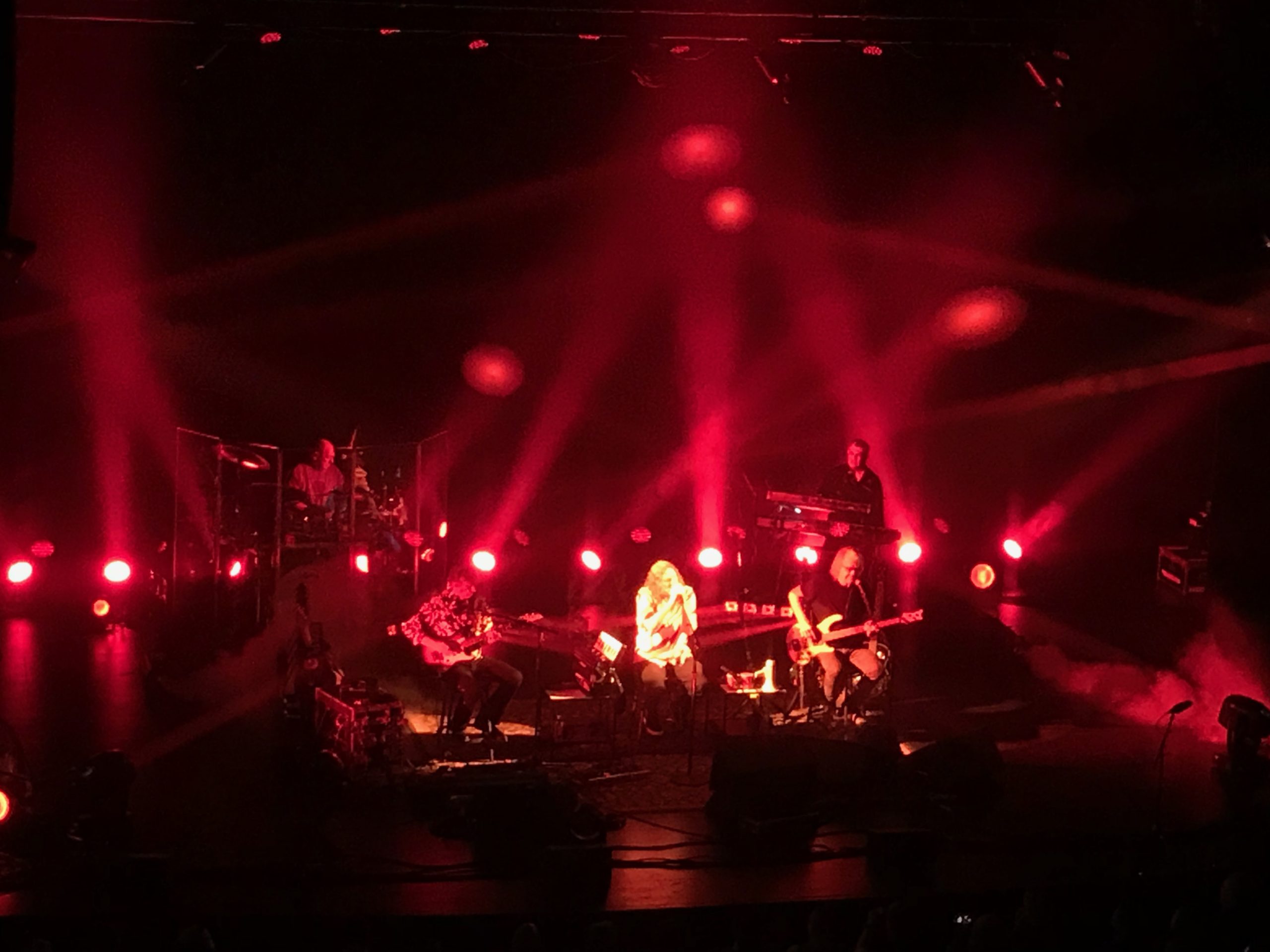
Midnight Oil, on their final tour, had packed the venue. The Riviera always seems to be about fifteen degrees warmer than outside of the building – and certainly more humid – and the night of June 10, 2022 was no exception. At least two people had to be helped from the main floor due to heat exhaustion during Midnight Oil’s set.
The Australian powerhouses put on a killer show that lasted over two hours and had two encores.
The first thing you notice when you see Midnight Oil is that lead singer Peter Garrett‘s voice has lost none of its power. He was hitting high notes and punk rage screams right out of the gate on “Nobody’s Child.” They thanked the Chicago crowd, stating that the city had always been good to them throughout their career.
There were a lot of great cuts, both new and classics. “Truganini” had everyone jumping. “Gadigal Land” and “The Dead Heart” had everyone singing along. It was also cool to hear “Kosciusko,” an oldie but goodie, and, of course, “Beds Are Burning” is still as powerful as it was when it was first released.
There was also, as to be expected at a Midnight Oil show, plenty of political talk and activism. The band highlighted the plights of Native Australians and Americans, the climate change crisis, the absurdity of the U.S. health care industry, and the circus of our political climate.
“King of the Mountain” and “Dreamworld,” each in its own encore, had everyone pumping their fists and getting charged up to change the world – which is always what Midnight Oil have wanted us to do.
Don’t miss them if they’re near you, or even if they’re a long drive away. Again, it’s their final tour. They’ve stated that they will continue to make music, but this is your last chance to see them live. They’re not the kind of band to do multiple “last tours” for a cash grab. They keep their word.
I scored this lovely and bargain-priced (twenty bucks!) mini-set of five classic albums by bossa nova queen Astrud Gilberto while on a late winter trip to California. The set covers records released by Gilberto (Yes, the first wife of Brazilian composer João Gilberto and stepmother to Bebel Gilberto.) from 1965 to 1969. In particular, they are her first (The Astrud Gilberto Album – 1965), third (Look to the Rainbow – 1966), fourth (A Certain Smile, A Certain Sadness – 1966), sixth (Windy – 1968), and seventh (I Haven’t Got Anything Better to Do – 1969) records, and all of them are delightful.
The first album pairs her with the legendary Antonio Carlos Jobim, who wrote her famous hit “The Girl from Ipanema.” Like that song (which is not on this record, but rather on the other classic Getz / Gilberto), this album is an instant mood-changer. Starting with “Once I Loved,” and Gilberto singing that “love is the saddest thing when it goes away,” everything around you adapts to her voice. Her duo with Jobim on “Agua De Beber” is another song that brings a smile to your face, and Joao Donato‘s piano on it is a delight while Jobim’s subtle guitar strumming hits harder than most metal records. Gilberto sings about the nerves associated with new love on “And Roses and Roses” while snappy percussion sizzles and soothes behind her. “How Insensitive” is heart-breaking yet alluring. “Dindi” is a bossa nova standard, and Gilberto does a great version of it here.
Look to the Rainbow is full of stunning arrangements by Gil Evans. Opener “Berimbou” would fit into a 1960’s Bond film with its lush horn section and exotic strings. The horns on “Fervo” might inspire a wild party in the streets. “Maria Quiet” is, I’m sure, being played in a Tiki bar somewhere right now. “Bim Bom” is peppy and bouncy, sure to flood a dance floor in that Tiki bar. “El Preciso Aprender a Ser So (Learn to Live Alone)” is one of those songs Gilberto pulls off so well – longing and yearning mixed with Zen-like detachment.
A Certain Smile, A Certain Sadness teams Gilberto with the Walter Wanderley Trio. Wanderley was an organ maestro who played on “The Girl from Ipanema,” and his band (Jose Marino – bass, Bobby Rosengarden – percussion, Claudio Slon – drums) are all sharp pros. The first two tracks are the double title tracks and both are bossa nova lounge classics. Wanderley’s organ riffs on “Nega” are the sounds of a hundred drive-in intermission countdowns, and Gilberto’s playful vocals on it are a delight. “So Nice (Summer Samba)” is another bossa nova classic, and it’s great to hear Wanderley strut his stuff on it while Rosengarden adds some spicy beats Any melancholy you might be feeling is wiped out by “Goodbye Sadness (Tristeza).” If the closer, “It’s a Lovely Day Today,” doesn’t cheer you up, I don’t know what will.
Windy was cut while Gilberto was living in Philadelphia and raising her and João’s son, Marcelo (with whom she shares vocals on “The Bare Necessities”). A lot of the songs are the album are big and bold, suitable for a Las Vegas nightclub or your party’s hi-fi. Opening track “Dreamy” is a perfect example with its lively brass section. “Never My Love” exudes soft 1960s psychedelia. She nails the title track (a cover of the classic hit by The Association), taking on the identity of the mysterious, playful woman as her own. Her cover of The Beatles‘ “In My Life” is also lovely.
According to the liner notes, Gilberto calls I Haven’t Got Anything Better to Do her “fireplace album.” She wanted to make a record that moved away from the aggressive sounds dominating the 1969 airwaves and could be listened to while curled up next to a fire. She did it. “He’s got a problem if he thinks I need him,” she sings on the opening title track. She had divorced João by this point, so you can’t help imagining her singing that in his direction. The soft, subtle horns on “Wailing of the Willow” mix perfectly with Gilberto’s haunting voice. “The Sea Is My Soil (I Remember When)” again makes you wonder why Gilberto never sang the theme to a Bond film. Everyone can relate to “World Stop Turning” at one point or another as Gilberto wishes time would stop so she could stay in bed with her husband just a bit longer.
It’s a wonderful collection, and a great way to be introduced to her music and bossa nova.
Los Angeles based unsung guitar hero Randy Holden announces the sequel to his legendary 1970 album Population II, set to arrive 52 years later, titled Population III via RidingEasy Records. The ex-Blue Cheer guitarist’s new album was recorded as a trio with members of Cactus and Black Sabbath. Hear and share the first single “Swamp Stomp” via Brooklyn Vegan HERE. (And direct via Bandcamp and YouTube.) How do you follow up one of the most legendary, yet rarest albums said to signal the birth of doom metal?
If you’re Randy Holden, you give everyone about 50 years to catch up, then casually drop a tastefully modernized reinterpretation of that sound. Population III picks up where Holden’s 1969 solo debut left off, updated with several decades worth of technological advances and personal hindsight.
Following his tenure in proto-metal pioneers Blue Cheer in 1969, the guitarist aimed for more control over his next project. Thus, Randy Holden – Population II was born, the duo naming itself after the astronomical term for a particular star cluster with heavy metals present. Along with drummer/keyboardist Chris Lockheed, Holden created what many say is one of the earliest forms of doom metal.
“Godzilla just walked into the room. People just stood there with their eyes and mouths wide open,” Holden says of the audience’s reaction to their live debut performing with a teeth-rattling phalanx of 16 (sixteen!) 200 watt Sunn amps. Likewise, their 6-song debut album Population II delves into leaden sludge, lumbering doom and epic soaring riffs that sound free from all constraints of the era. It’s incredibly heavy, but infused with a melodic, albeit mechanistic sensibility. However, troubles with the album’s original 1970 release bankrupted Holden, who subsequently left music for over two decades. For good reason, it’s widely hailed as a masterpiece, and until finally getting a proper formal release in 2020 on RidingEasy Records, was a longtime Holy Grail for record collectors.
Flash forward 40 years to 2010, we find the guitarist/vocalist quietly coaxed into recording a followup album by Holden superfan and Cactus member Randy Pratt. Joined by drummer Bobby Rondinelli (who has played with Black Sabbath, Blue Öyster Cult, Rainbow), the trio cut the 6-song collection of leaden future blues, Population III. “Randy Pratt had written the basic song structures, he understood my music and where I come from quite well,” Holden says. “He nailed it.”
But the recording was ultimately shelved for over a decade. “A year ago, in 2021 I listened to the songs and was delightfully surprised,” Holden says. “I think it’s the best album I’ve ever done.”
Throughout Population III, Holden effortlessly dishes out squealing, soaring leads and skull-thwacking riffs with his signature low end grit and penchant for Middle Eastern scales. Coupled with Pratt’s pocket-locked bass, the slight flanging effect on Rondinelli’s drums and his pugilistic beats, the album occasionally brings to mind Presence-era Led Zeppelin, particularly on the 22-minute epic “Land of The Sun.” Elsewhere, “Swamp Stomp” echoes more the troglodyte blues of Holden’s older work, with his evermore searing solos showing hints of early Clapton/Hendrix era guitar prowess to drive home the stomp of the song’s namesake. At times, Holden sounds reminiscent of Neil Young leading Crazy Horse’s ruptured grunge as his lilting falsetto vocals push and pull his guitar’s siren’s call. Taken as a whole, there’s a very distinct difference between the way these veterans of hard rock’s formative years carry the songs compared to the more lugubrious riffing of today’s young doom purveyors. Population III is the real deal — a powerful continuation of a sound forged 50 years ago, that almost didn’t happen. Somehow, Randy Holden’s music always finds a way to stand the tests of time.
Population III will be available on LP, CD and download on July 1st, 2022 via RidingEasy Records. Pre-orders are available at ridingeasyrecs.com
Pastor Champion, who left us for the Kingdom of Heaven just as his music was being discovered, was a man of many hats: Pastor, former gang member, touring guitarist, brother, and probably many others we’ll never learn about unless secret diaries or obscure notes are found.
We do know that he preached and played for the 37th Street Baptist Church in Oakland, California. We also know that his one and only album, I Just Want to Be a Good Man, was recorded with musicians who’d never played with him before then, and it was recorded in just two nights at his church. We also know that it’s a stunning record of gospel, blues, and soul that, if there’s any justice in this valley of tears, will win a Grammy for Best Gospel Album.
Champion pleads with people to come back to the church and Christ on “I Know That You’ve Been Wounded (Church Hurt)” – a song for those who have been disappointed, hurt (physically, mentally, and / or spiritually), or crushed by the church, religion, and families and friends practicing their faith in hurtful ways. “Keep on, God will make it work,” Champion sings over simple chords that almost sound like he’s playing a ukulele.
“He’ll Make a Way (Trust in the Lord)” further emphasizes the theme of relying on faith, and the power of Champion’s faith is evident from the first notes he sings in it. The nearly seven-minute “Talk to God” has Champion grooving with these church musicians he’s barely met, and all of them slide right into his groove with the ease that comes so naturally to accomplished gospel musicians.
“Only what you do for Christ will last,” Champion sings on “In the name of Jesus (Everytime)” – a reminder to put the Creator in the lead and trust His guidance. Hearing Champion teach his impromptu band how to play “To Be Used, by You (I Just Want to Be a Good Man)” is fun to hear, and the rest of the track is lovely (and a warm-up for the closing track).
“Who Do Men Say I Am?” has Champion singing a conversation between Christ and His disciples (from the sixteenth chapter of Matthew). “Storm of Life (Stand by Me)” has Champion crying out to God about troubles that plague him at work, at home, at church, and practically everywhere else – including his worry that he might not be ready for death. “In the Service of the Lord” has some of Champion’s most passionate vocals, and that’s saying something when you consider how much he professes his face throughout the record.
The album closes with the title track, expanding on the earlier version of it with, somehow, even more soul and longing. “Tell me, tell me, tell me, Jesus, what do you want me to do?” Champion sings.
He’s doing things we can’t even fathom now, but at least we have this record as a light in gloomy times.
“’The Internet Killed Me’ is a euphemism for being killed – by the internet – literally and figuratively. You wouldn’t know it until it actually happens to you. I mean the internet LITERALLY killed me. AND the internet FIGURATIVELY killed me. It’s up to you to know the difference. Be afraid. Be VERY afraid,” said Max Blastic of the :58 second song that was written after P.C. Bullshit was erroneously reported dead via the r/punk Subreddit.
Bullshit and Blastic previously shared the “Burn It Down” video (https://youtu.be/EyDaVp3ReL0), which came on the heels of an outpouring of accolades and testimonials from fans and friends upon news of the influential band’s implosion. “I feel we’ve made the record we meant to have made back in the day. If the topics seem familiar, well, WE WROTE THEM FIRST,” Blastic said as the joyous reunion and album news arrived. “I don’t actually REMEMBER what the songs are about but I KNOW we were the first and the best. We were and are ALWAYS the first and best.”
Blastic is the featured guest on this week’s episode of The Punk News Podcast (listen here), discussing the infamous $262 gas bill that led to the untimely break-up, Nein, and the duo’s forthcoming tour.
Nein pre-orders are available now (https://linktr.ee/maxcreeps) with several, limited-edition vinyl variants available via U.S. and international retailers, Maxcreeps.com and Project M (Revolver, Brooklyn Vegan, The Hard Times).
The “Nobody Cares About You – Part One!” tour dates:
I don’t know what I can write about Black Sabbath‘s classic sophomore album, Paranoid, that hasn’t already been written. It’s a metal classic, a doom classic, a rock classic, and a British classic. I think the only thing I can write about regarding the album is how, until I finally got around to listening to it in its entirety, it’s also a psychedelic classic.
I mean, the opening track, “War Pigs” (originally titled “Walpurgis” – a song about witches but later altered to reflect the horrors of the Vietnam War), is a doom anthem, of course, but the opening riff and air raid sirens are an instant mind trip. Tommy Iommi‘s solo in the middle of it is the glint in the eye of doom metal’s father, but all of his work on the track has a trippy quality to it that’s hard to define.
The title track is the start of thrash metal, and, as the story goes, came about from the band goofing around in the studio. Little did they know it would become their first mega-single. Ozzy Osbourne‘s slightly fuzzed vocals balance well with the cranked fuzz of Iommi’s guitar and Terry Butler‘s bass and Bill Ward‘s relentless, yet precise drumming.
“Planet Caravan” then does an abrupt left turn into full-blown psychedelia. Osbourne’s vocals are barely perceptible, and the whole thing sounds like it was somehow sung and played through a lava lamp. Everything about it is warped and weird. I thought, “Why isn’t this song considered one of the classics of the psych genre?” when I first heard it. Mind you, I’m sure it is, but it seems like it’s a sadly overlooked Sabbath gem.
Probably because the next track is “Iron Man,” which has been featured in everything from Marvel movies to The Simpsons by now. Everyone remembers the riffs, but how many remember the song is about an astronaut who sees the Earth’s future, returns to warn us about it, is ridiculed by humanity for doing it, and then decides to trash us for mocking him?
Iommi makes full use of his effects pedals on “Hand of Doom,” which again has heavy riffs but part of their weight comes from the psychedelic touches the band puts on it. It’s creepy, sure, but also mind-altering – especially when they get to the bridge and it almost turns into a prog-rock track. The slick “Rat Salad” continues the brain-melting effects by starting off with adder-like slithering bass from Butler that explodes into a panther pouncing on you when the whole band kicks into gear. The song does this over and over, leaving you unsettled and somehow exhilarated. The closer, “Fairies Wear Boots,” is a dig at Nazi skinheads who were coming to their shows, is chock-full of great hooks, and even has a groovy intro (known as “Jack the Stripper”) with a somewhat bonkers Ward drum solo.
I know many fog hats were worn while listening to Paranoid and many “left-handed cigarettes” were rolled on its cover. I know I shouldn’t be surprised that it’s an album that easily moves back and forth between doom and psychedelia, but yet I still am. That’s a testament to the album’s craftsmanship.
Keep your mind open.
[Get on the 7th Level Music caravan by subscribing.]
TheStaples Jr. Singers share “I’m Looking For A Man,” from the forthcoming reissue of their sole album, When Do We Get Paid, originally released in 1975, out May 6th on Luaka Bop. In conjunction, the family from Aberdeen, Mississippi, share a live performance video of the new single recorded this past January, and announce a slate of performances in New York City taking place on Saturday, April 23rd, at Baby’s All Right, The Lot Radio, and Friends & Lovers.
Following an invite-only, press preview at The Paris Review in Chelsea, these concerts will be the Staples Jr. Singers’ first performances as a group in over 40 years. It will be their first-ever visit to New York City, as well as an extremely rare appearance outside the South. Presented by Luaka Bop and Boom Collective, this ambitious series of shows—three in one day!—will begin with a “Gospel Brunch” at Baby’s All Right in Williamsburg, then move outdoors to The Lot in Greenpoint, where the Staples Jr. Singers will be broadcast live on-air. While these first two shows will be free, the day will be capped off with a grand finale, an extended set at Friends & Lovers in Crown Heights. It may be one of the best performances that you’ll see all year. The original members of the family band—the siblings Edward Brown, A.R.C. Brown, and Annie Brown Caldwell—will be joined onstage by members of Annie’s family, including her husband Wille Caldwell Sr. and their children Willie Jr., Abel, and Deborah. For tickets, RSVP and more information, go to JuniorSingers.com.
Like many gospel groups at the time, the Staples Jr. Singers were a family band: Annie Brown Caldwell was 11, A.R.C. Brown was 12, and Edward Brown was only 13 when they started playing school talent shows, local churches, and front yards near their hometown of Aberdeen, Mississippi, on the banks of the Tombigbee River. As was common practice among gospel acts, they named themselves after their idols: the Staple Singers. As their reputation grew, they started traveling across the Delta and the Bible Belt, piling into their family van on weekends to perform as many as three shows in a single day.
In 1975, at the time of When Do We Get Paid’s release, the Staples Jr. Singers were still just teenagers, and they sold the copies they pressed themselves at shows and on their front lawn to neighbors. With soul-inflected gospel songs that carried timely, subtle social messages, the Staples Jr. Singers responded to what they saw in the South: the struggles of the Black community, the backlash after desegregation, CivilRights.
While the Staples Jr. Singers have all gone on to write an entire catalog of gospel music since the era of When Do We Get Paid, for the original members of the band, the incantatory funk of this music still holds the power to help make a way out of dark and troubled times.
This project from Luaka Bop originates from their acclaimed compilation World Spirituality Classics 2: The Time for Peace Is Now – Gospel Music About Us (2019), which includes the Staples Jr. Singers’ single “We’ve Got a Race to Run” (Best New Music by Pitchfork (8.5), and listed among the best reissues of the year by NPR and Uncut). The compilation also resulted in the 2020 VinylFactory documentary, “The Time For Peace Is Now,” featuring Annie Brown Caldwell. The Staples Jr. Singers Live In New York City, presented with Boom Collective: Fri. Apr. 22 – New York, NY @ The Paris Review (press preview, invite only) Sat. Apr. 23 – Brooklyn, NY @ Baby’s All Right (11am) (RSVP needed, here) Sat. Apr. 23 – Brooklyn, NY @ The Lot Radio (3pm, live broadcast) (RSVP needed, here) Sat. Apr. 23 – Brooklyn, NY @ Friends and Lovers (7pm) (Tickets, here)
This was my third time seeing Gary Numan live, and it was the smallest venue I’ve seen him in so far. It was good to see a crowd of people happy to be experiencing live music again, and even better to see Numan and his band having a good time on stage.
His opening act was the one-woman band I Speak Machine, who came out looking like a Black Widow assassin and throwing down a set of darkwave mixed with kabuki, opera, and industrial grind. One of the best parts of her set was watching the reactions of some in the audience who didn’t know what to make of her, and of her not giving a damn what people thought.
I Speak Machine belting out operatic vocals for a dumbfounded crowd.
Mr. Numan came out to an appreciative crowd and proceeded to belt out a loud, sometimes furious set that mixed classics with hot tracks from his last two albums, Savageand Intruder.
Gary Numan being a rock god.
It was great to see him and his four-piece band having a good time. There were many moments when they were smiling or laughing. You could tell they were excited to be on tour. Numan’s guitarist, Steve Harris, was all over the stage, often mixing shredding solos with performance art antics. I’m fairly certain he broke a string or two just a few songs into the set from playing so hard.
Numan and crew
It was a great set, with standouts like “The Promise,” “Films,” “Ghost Nation,” “Love Hurt Bleed,” “Bed of Thorns,” “My Name Is Ruin,” “A Prayer for the Unborn,” and “Are Friends ‘Electric’?” Catch him if you can. He’s having a blast right now, and so will you.
Thanks to the woman who let me snap this photo of the set list she scored.
Today, International Anthem presents “Step on Step,”by the late Chicago producer, arranger, musician and composer Charles Stepney. Stepney died tragically in 1976, and his legacy includes essential behind-the-curtain work on world famous recordings by Rotary Connection, The Dells, Muddy Waters, Minnie Riperton, Ramsey Lewis, Earth, Wind & Fire, Terry Callier,and many many others. In his music – as producer, arranger, and composer – Stepney routinely transcended trend and convention. Much of Stepney’s work, including from his prolific days as a staff arranger at Chess Records in Chicago, employed prismatic horn and string arrangements (in some cases brought to life by the Chicago Symphony Orchestra). His arrangements – like the idiosyncratic underpinnings of “That’s The Way Of The World,” as recorded by Earth, Wind & Fire, “What Color Is Love” by Terry Callier, or “California Soul” by Marlena Shaw – are still squarely in our hearts nearly fifty years after their inception. His sound has been sampled countless times by artists such as A Tribe Called Quest, The Fugees, Kanye West, Jay-Z, D’Angelo, Gang Starr, and Jurassic 5. Yet all too many of us don’t know his name.
He was a genius relegated to the shadows, whose enigmatic lifeforce was snuffed out far too soon. However, his genius is being brought into brighter light by his three daughters, Eibur, Charlene, and Chanté Stepney, who have spent the greater part of their lives engaged in a quest to exalt their father’s legacy.
Today’s “Step On Step,” the first recording ever to be released under Stepney’s name, comes 3 days ahead of what would have been his 91st birthday. The song was recorded by Stepney to 4-track tape in the basement of his home, sometime in the late 1960s. It features Stepney layering his own performances on piano and vibraphone over a primitive drum machine. It is perhaps the most stripped down impression ever heard of Stepney, an artist known for his epic, orchestral arrangements.
This “Step on Step” single is just a beginning. There will be much more news and music to come from The Stepney Family together with International Anthem in 2022. #SummerOfStepney
Keep your mind open.
[Step on over to the subscription box while you’re here.]