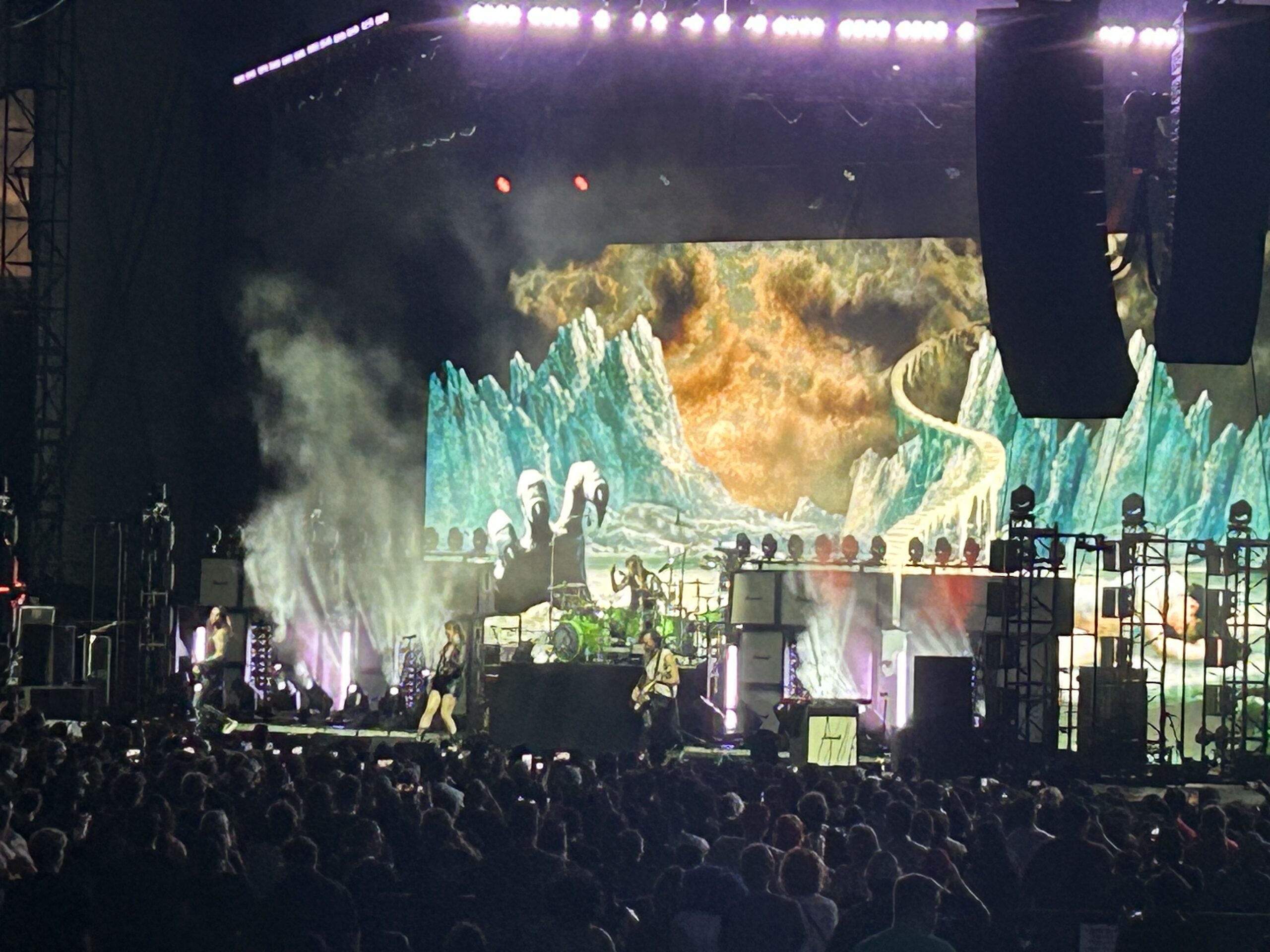
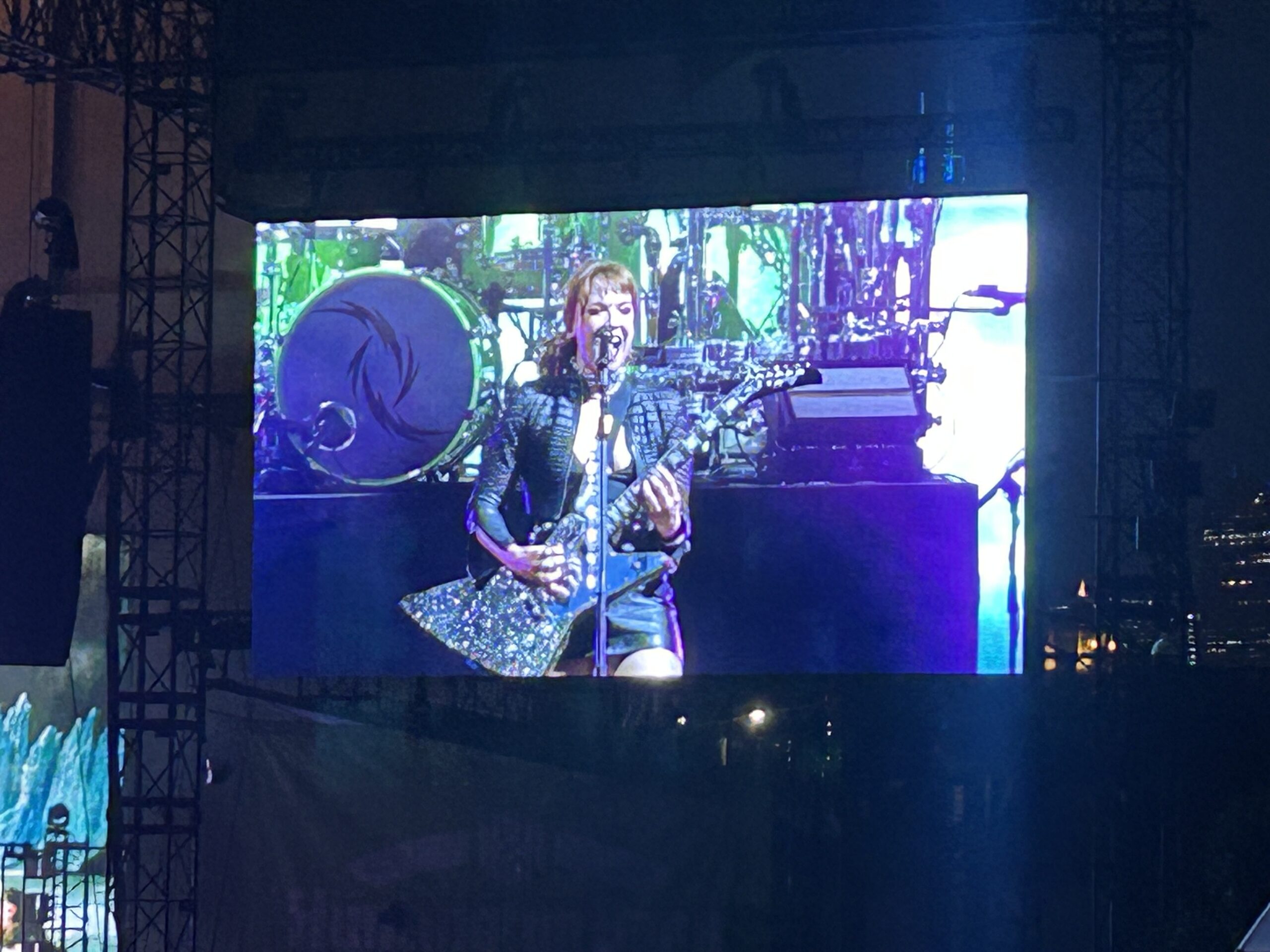
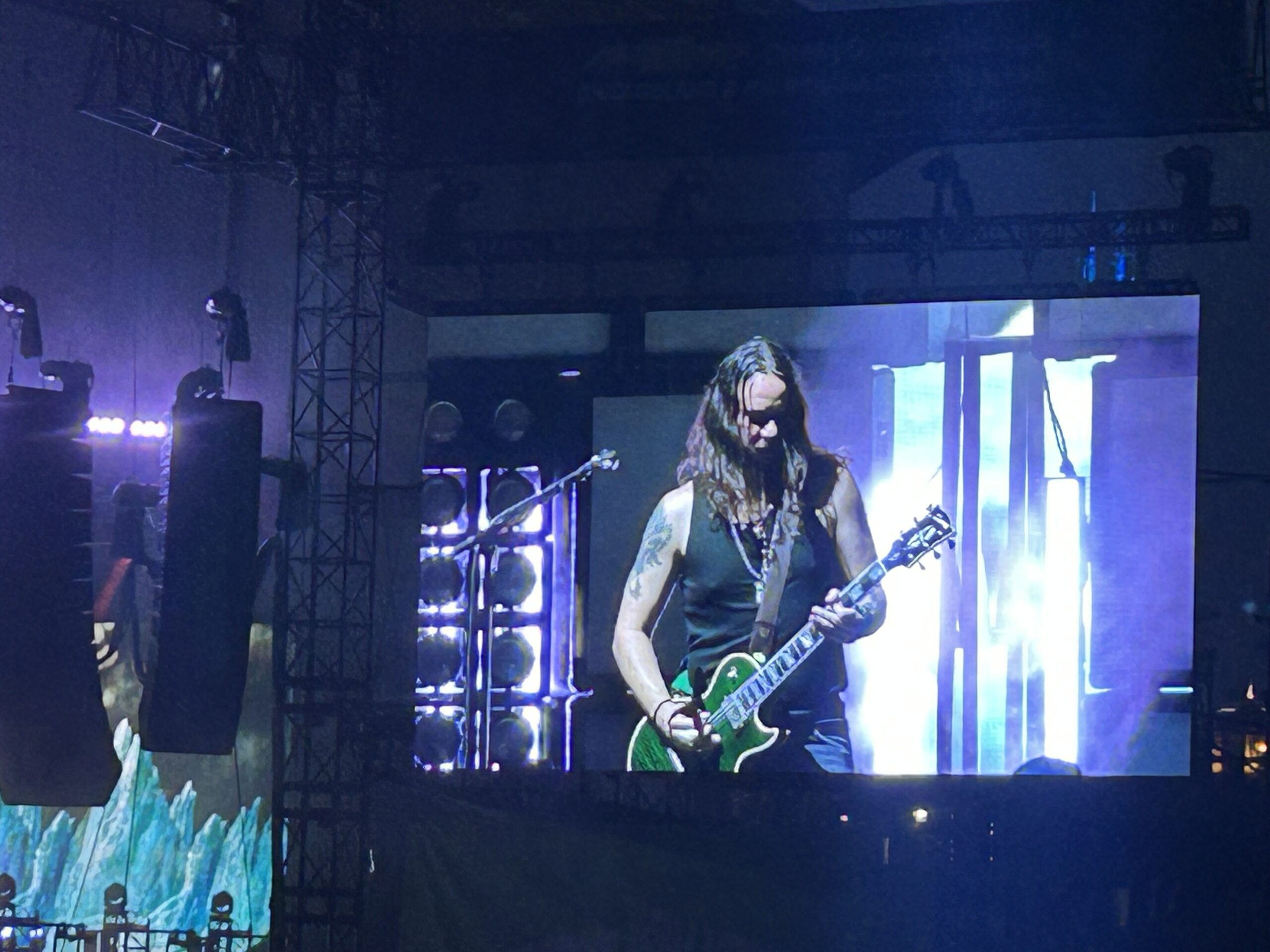
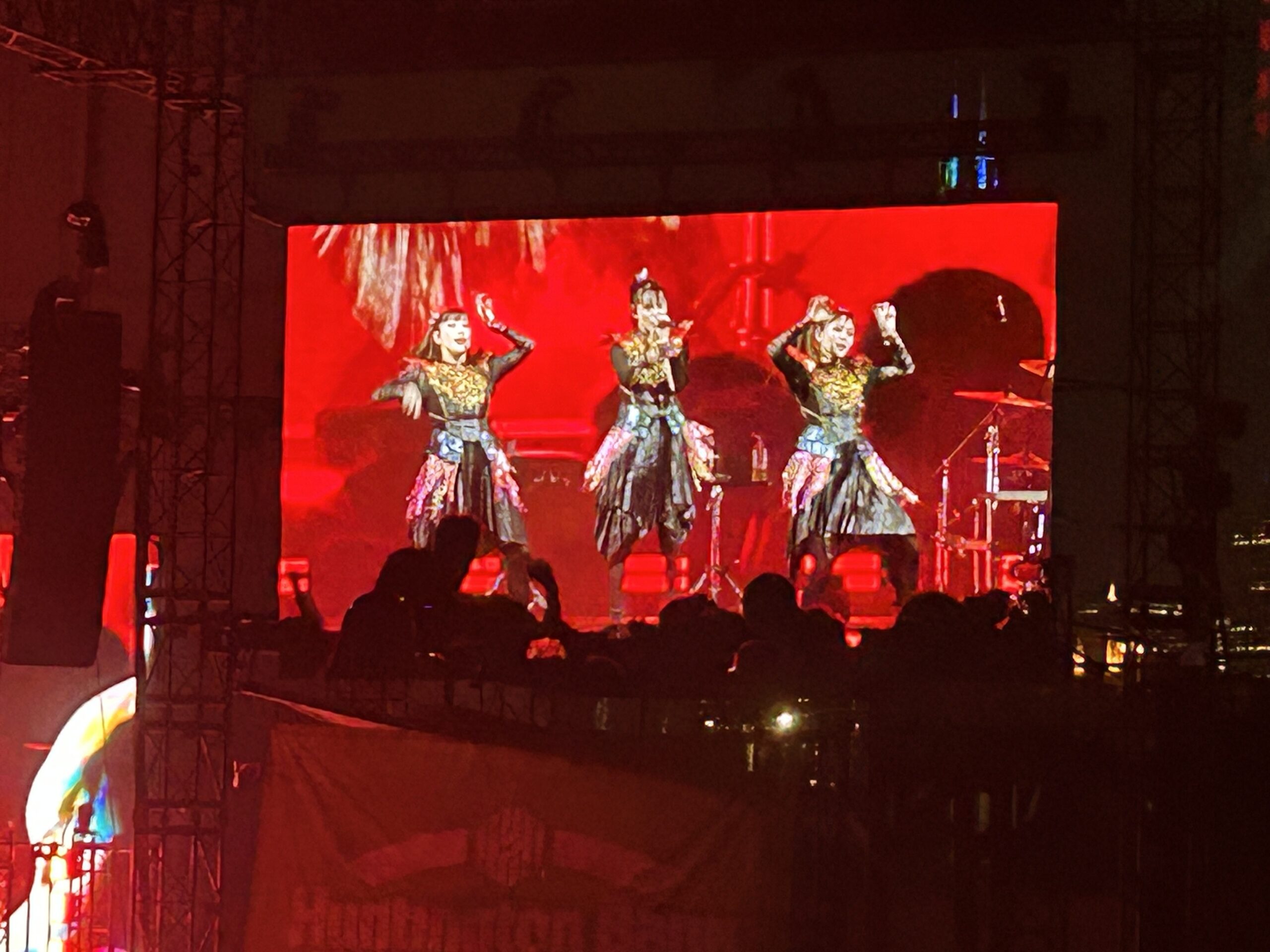
The area around the Old National Centre in Indianapolis was full of people in energy dome hats in anticipation for Devo’s first concert in the city for decades. One of the best parts was seeing the wide age range of fans. My friend, Bill, brought his two young boys, Lexington and Phoenix, with him and they were as hyped for the show as old timers who’d been catching Devo shows since the 1970s.
They came out with energy that men twenty years younger than them wish they had, opening with “Don’t Shoot” and “Peek a Boo.” The crowd barely stopped jumping and dancing the entire time.
Peek-a-Boo, Devo can see you.
“Going Under” was a nice surprise, and Mark Mothersbaugh almost lost his voice by the time they got to “Girl U Want” and “Whip It,” but he had time to recover during “Planet Earth” – a song I didn’t expect but was delighted to hear.
“Blockhead” was another fun deep cut, and “Jocko Homo” shredded the stage. My friend said, “It sounds even more punk live.”
Are we not men?!
“Smart Patrol / Mr. DNA” was another bonkers track (Bob Mothersbaugh breaking all of his guitar strings at one point), with the triple whammy of “Freedom of Choice” (“Use it or lose it, spuds. It’s going fast,” said Bob Casale), “Gut Feeling,” and then “Beautiful World” (sang by Booji Boy) to wrap up the show. It left everyone out of breath by the end.
They’re the Smart Patrol.
Devo have still got it, and they were right all along. They saw all of everything you see today coming decades ago. They warned us. They still are.
Keep your mind open.
Thanks to the pro-photographer who let me snap a photo of this set list!
If you weren’t aware, The Black Angels are currently on tour to celebrate the 20th anniversary of their debut album, Passover. They’re playing the whole album front to back and a second set of favorites and new material. Their recent return to Chicago’s Thalia Hall was a sold-out affair with spooky psych-rockers L.A. Witch opening for them.
I think this kind of lighting follows L.A. Witch wherever they go.
L.A. Witch played a smoky, spooky set of psych-rock mixed with California garage rock and a bit of doom metal. Their drummer, Ellie English, is sharp and puts down heavy krautrock rhythms at times. They also have a cool wall-of-sound vibe to them that washes over you and can induce a hypnotic state.
Same thing with The Black Angels, really.
Passover launched the careers of the Austin, Texas psych-heavyweights, and the album is still powerful in its message of the insanity of war…which is, unfortunately, also still relevant twenty years later with even just the first two tracks: “Young Men Dead” and “The First Vietnam War.”
“Black Grease” has always been a favorite of mine, so it’s a treat to hear it live, and “Manipulation” has grown into one of their best live pieces as Christian Bland and Alex Maas trade lead vocals throughout it and everyone gets trippy with it. After seeing Stephanie Bailey pound her kit during the back-to-back endurance contests of “Empire” and “Better Off Alone,” my guess is that she carb-loads like a triathlete before each show. By the way, she came out on stage on crutches and still rocked the entire set.
After a brief break, they came back with the ever-cool “Bad Vibrations” and then multiple new tracks: “Push It” (not a Salt & Pepa cover), “Daisies,” and “Turkish” among them. Their new album is going to be a stunner if these are any indication of its sound.
The bad vibrations are actually pretty good.
Don’t skip this tour. The new edge to the Passover songs is heavy and sometimes menacing, and the new songs will amaze you.
Sebastian Murphy, lead singer and songwriter for Swedish post-punk giants Viagra Boys, said their latest album, Viagr Aboys, was an exploration of real life meeting high art and that the album is admittedly “a bit simple and stupid,” because he and his bandmates were exhausted by world politics and wanted to create something fun. Even the album art is goofy, as Murphy wanted the band’s name to be symmetrical on the cover and it ended up split in half.
Is life art or is art life? That’s the overall theme of the album. “Man Made of Meat” gets the album off to a fun start with call-and-response vocals about Internet culture and how it turns people into constant consumers and promoters (“I hope they see me in the drive-thru lane!” / “I don’t want to pay for anything. Clothes and food and drugs for free. If it was 1970, I’d have a job in a factory.” / “I’ve subscribed to your mom’s Only Fans.”). “The Bog Body” is based on a real museum exhibit of exhumed, preservered bodies found in bogs that Murphy’s girlfriend became somewhat obsessed with, which Murphy found fascinating. Again, life is art, and the reactions to it, often pompous ones, can be humorous (“Do you even know the difference between a swamp and an ancient bog?”).
“Uno II” is a goofy tale about Murphy’s dog and the constant veterinarian bills she produces. Elias Jungqvist’s synthesizers and Oskar Carls’ flute turn the story into a somewhat dreamy tune. “Pyramid of Health” has Murphy facing how his partying life is affecting his body and all the weird advice he’s received to fix it. “Dirty Boyz” is another witty takedown of bro-culture with killer beats from Tor Sjödén.
“Medicine for Horses” could be about ketamine, but it’s really about wanting to do something significant before one’s death and being remembered afterwards. Carls’ saxophone is as lonely as Murphy’s voice. “Waterboy” references dancing, singing raisins and aimlessly wandering through life without purpose (“Livin’ like this, you won’t live long.”). “Store Policy” is so angry and rough that it’s probably based on a true story that happened to Murphy. Henrik Höckert’s bass is, as always, thick and crushing. The grooves he creates are often jaw-dropping. The whole band hits hard on it. Carls’ flute notes stab at you, Linus Hillborg’s guitar sounds like a bandsaw breaking down, Jungqvist’s synths throb like Bruce Banner turning into the Hulk, Sjödén’s beats go full-cyborg, and Murphy snarls and growls the whole time.
“You N33d Me” gets you dancing (again, that bass by Höckert!) and is another spin on how many people have gleefully allowed their lives to become art / products to be consumed by others. “Best in Show Pt. IV” (another one about life being displayed as an exhibition) is the longest track on the album as Murphy seems to be speaking stream-of-consciousness lyrics about weird trips and how he’s losing his mind (“I need access to heaven, or ain’t none of this is gonna work out.”). “River King” is just Murphy’s voice, Jungqvist’s piano, and Carls’ saxophone spinning a tale of Murphy’s desire for a lost relationship.
You get four extra tracks if you pick up the Japanese deluxe edition of Viagr Aboys: “Therapy II” (a bit of a riff “The Bog Body” grooves with a definite Devo influence), “Middleage(d) Humanoid” (with Höckert’s bass as heavy as Thor’s hammer), “Watching You” (a cool showcase of Jungqvist’s skills and Sjödén’s programmed beats), and “Cumboy” (in which Hillborg demonstrates that he can play shoegaze anytime he wants).
Yes, art is life and life is art. There’s more to it than politics, Internet clicks, maxing, and fleeting fame. Viagra Boys have been reminding us about this (and warning us of the embrace of toxicity) for years, and Viagr Aboys is another important message from them.
And it’s silly, which is much needed in today’s world.
The cover of Pale Blue Eyes‘ This House features a photo of the house and parents of lead singer / guitarist Matt Board. Everything in that photo is gone now. Well, the house might still be there, and Board’s memories of it are still intact, but it has new inhabitants now. The lawn is probably different. The decorations in it are different, and the people now living in it are building their own lives while Board, after losing both his parents within five years of each other, is still building his. The album is about loss, but also embracing the change that comes with loss.
The album begins with “More” (as in there is more after loss, if you allow it) as Lucy Board‘s synths and programmed beats immediately bring light and hope, and Aubrey Simpson‘s bass groove gets your feet tapping. As if that wasn’t catchy enough, “Simmering” is even peppier and encourages us to examine the “before and after” when you’re faced with a life-changing event.
After all, there’s “no turning back” after such a thing. You just want to “Hang Out” and let it drift by you “because I don’t want to talk about it anymore.” Sometimes you have to be still…although this track is tailor-made to get you to dance. Put it on at the party you throw to alleviate your sadness. It’s perfect. Mrs. Board’s synths and programming on “Spaces” sounds like transmissions from outer space.
Simpson’s bass on “Heating’s On” sounds like something from a lost Go-Gos track. Mr. Board’s guitar goes all shoegaze on “Our History,” and it’s a gorgeous wash of sound crashing over you. “Million Times Over” slows things down just a bit, but the dance beats (and spooky synths) return with “Illuminated.” “Sister” is another shimmering shoegaze stunner. Looking for motorik? Don’t worry. Pale Blue Eyes have you covered with the snappy “Takes Me Over.”
The record ends with the lush “Underwater,” as if you plunged into a backyard pool at the end of a long day or late at night when the party is winding down and it’s just you and a couple close friends. You know things will be okay. You can embrace the shock, the cold, and you can embrace the support and the warmth. It’s all okay.
Take psych-rock / ye-ye giants The Limiñanas and combine them with DJ / producer Laurent Garnier and what do you get? De Pelicula – a super-groovy, super-trippy album that tells the tale of two lovers in a film soundtrack format. The album’s title even means something akin to “like something out of a film.”
“Saul” is a mysterious track about a man who loves film and music but isn’t happy with life until he meets a young woman and decides to leave everything behind to follow her. Saul (“A small town guy.”) and this woman, Juliette (A “beautiful and gentle” prostitute), are prominent figures throughout the record. “Je rentrais par le bois…BB” (“I was returning / coming home through the woods…BB”) is a slightly frightening psych-drone track with Garnier’s synths creating a weird landscape and Marie Limiñana‘s beats creating a slightly paranoid sense.
“Juliette dans la caravanne” (“Juliette in the trailer.”) has Saul meeting Juliette in her 1960s trailer for a rendez-vous that changes his world and unsettles him. “Que calor” brings in Spanish lyrics instead of the French you’ve heard so far. Lionel Limiñana uses a mellotron and organ to neat effect here and the entrance of his fuzzy guitar turns your head into a strong wind.
“Promenade oblique” is another solid instrumental track with a groovy bass line from Lionel. “Te tournes en boucle” (“You’re turning / going in circles.”) is a twisting, looping track that details Saul feeling lost until Juliette shows up to pull him back into a clearer headspace. “Steeplechase” races along with some of Marie’s snappiest drumming and Garnier’s spy movie car chase scene-like synth pulses.
“Juliette” is the tragic backstory of the female half of our lovers in this tale, told through haunting synths and raging guitar. Juliette, born to a single drug-addicted mother, drifts into drugs and eventually kills a pastor who takes advantage of her…only for her to end up a party girl on drugs and having sex for money. “Ne gâche pas l’aventure humaine” (“Don’t spoil / waste the human adventure.) repeats the lyric of “Je t’aime.” (“I love you.”) again and again as siren-like synths give us a warning of what’s ahead for our star-crossed lovers.
“Au début, c’était le début” (“At first, it was the beginning.”) has Garnier taking lead vocals that sound like he’s mourning for lost times, reflecting Saul’s wish for something better for he and Juliette. He doesn’t get those better times, however, because at the end of the album, on “Saul s’est fait planter,” (“Sault got stood up.”), Juliette leaves him. She gets on a train and never returns. That’s French cinema for you.
It’s a cool record telling a cool story with cool grooves. You won’t regret taking this trip.
It’s no surprise that Rare DM (Erin Hoagg) titled her new, entirely self-produced and recorded album Attention. The whole thing demands your attention, and your pulse.
Opening track “Compliment” hits all the right beats and gets your pulse elevated for what’s to come. You’ll need the energy for all the dancing, and Rare DM’s often breathy vocal delivery is as seductive as the beat. “The Ring” throbs in your head and your hips, and, yes, it’s about the Japanese horror film Ringu and the wicked ghost in it who slays people via VHS tape. Rare DM loves blends of music and visuals, technology and humanity, sex and science fiction. It’s a perfect fit.
“Honey” has a drifting, floating, tactile sound that sounds like a cool darkwave track you haven’t heard in years. The question on Rare DM’s mind at the beginning of “Mean Girled” is “We’re not even fuckin’, but am I worried about you?” She’s trying to figure out a weird relationship dynamic and if it’s worth taking to another level or if she should just walk away.
“Butterfly Historian” is drenched in muted bass and sultry sweat. “325” might be the best love song about a vehicle since Queen‘s “I’m in Love with My Car.” Speaking of vehicles, the next track is “LA Traffic,” in which Rare DM laments (over drum and bass beats) over being stuck in it while friends wait for her at the club. “Lil DM” has her wishing for at least a night free of phone calls and e-mails.
“Skater Hits Me Harder” has Rare DM looking back on an adolescent crush through the lenses of adulthood and time. “Significant Other” is an instrumental banger. “Do you like me better, now that I’m like you?” Hoagg asks on the near-industrial “Feel Nothing.” She’s come to realize that she doesn’t need what her lover is selling. The album ends with the lush “Landed,” showcasing Hoagg’s misty voice and sunlight-through-the-fog synths (most of which, by the way, are vintage gear she’s collected from all over NYC).
Pay attention to this album. You’ll notice something different every time.
Widely regarded as one of the breakthrough albums of French house music, let alone one of the classic 1990s house music albums, St. Germain (AKA Ludovic Navarre) premiered on the scene with Boulevard and stunned everybody.
The opening track, “Deep in It,” clocks in over seven minutes and drops killer vibraphone beats from Miguel “Punta” Rios on top of snappy electro-beats to get you deep into the sexy Parisian nightclub at 2am. That track is practically a warmup for “Thank U Mum (4 Everything You Did),” which is over twelve minutes of sizzling percussion and smoky bass and sounds like it samples Lightnin’ Hopkins vocals to make the track even groovier.
“Street Scene (4 Shazz)” has great flute work from Malik throughout it that elevates the 15-plus minutes into a great jam. “Easy to Remember” has a great trumpet line throughout it from Pascal Ohsé. Édouard Labor‘s saxophone takes the lead on “Sentimental Mood” and pairs with Alexandre Destrez‘s poppy piano quite well.
“This is what we call easy listening, underground house music,” someone says on “What’s New?” before the floor-filling dance beat drops. “Dub Experience” is a laid back change of pace from the house beats that have propelled the album through the first six tracks, and the closer, “Forget It” is something you’ll remember thanks to its wicked beats and sensuous grooves.
It’s a classic album that still sounds like it could’ve been released yesterday and set the time for Tourist, which is one of the greatest make-out albums of all time.
Keep your mind open.
[Stroll over to the subscription box while you’re here.]
Miss Grit‘s new album, Under My Umbrella, is an album about loneliness – both the embrace of it and the sadness of it. Loneliness can be liberating at times. It can feel great to be on your own with endless possibilities before you. It can also feel crushing, like your world has stopped and no one even thinks to look for you while they’re rushing around outside.
The pulsing, symphonic synths of “Tourist Mind” build to an upbeat outlook as you drop the car into drive and head out for a solo road trip to wherever you’d like (as Miss Grit / Margaret Sohn did around North America during a tour). When they sing, “I never wanted to be so alone,” you can’t tell if they’re happy or sad about it. It could be both depending on the moment. “Mind Disaster” sizzles with electric hums and Sohn’s modulated voice sounding like a robot awakening from a weird dream about someone they can’t place but whose presence they can still feel.
“I Won’t Count on You” has Sohn embracing the idea of not having to rely on someone (“I’m going to enjoy this. I won’t count on you.”). “It Feels Like” could be a shoegaze track if you swap the synthesizers for distorted guitars. “Where Is My Head?” is a hypnotizing trip-hop track with Sohn repeating simple lyrics like “You’re all so free.” and “You’ll never see inside of me.” as bubbling, brewing beats and bass surround them.
“Stranger” has Sohn feeling alone as a lover grows detached from them and they’re just trying to keep up before the race is finished. “You Will Change” seems to be about making your way out of the maze of grief with lyrics like “And one day it could all change. While you wait for pain, your heart will go on pushed into another day.” The track (appropriately) flows into “Overflow” – a song about wondering if you’ll know when it’s time to leave a relationship or if you’ll only realize after the other half has left.
The album ends with “Waste Me.” It’s a bit upbeat even though Sohn’s lyrics are sprinkled with sadness (“And it’s very me to feel misunderstood, but I barely try to explain myself to you.”). Sohn is facing the fact that they’re going to be alone, again, for a while, and that might be okay. They’ll just have to ride it out.
It’s all any of us can do, really, but this album helps you navigate it by not feeling so alone.
Keep your mind open.
[Subscribing for music news and reviews might help alleviate loneliness.]
There’s a strange thing that happens when you go through a heavy grief process. Sure, you have all the agony, regret, emptiness, and at least brief moments of madness, but sometimes, after the dust settles a bit, you also have a moment when you realize you can, will, and must continue your journey. It’s an empowering, powerful flash of insight that can zip past you if you’re not careful. You have to grab it when it arrives. It might not return.
Lauren Lakis grabbed it while making her excellent new record Deadlights. She’d already lost friends and family to addictions as she grew up the kid of a single mom in Baltimore. She turned to music and film to make sense of it all, joined some bands, and went around the world. While singing in one of those bands, she went through a bad breakup and then learned her mother had been in a car accident that left her paralyzed.
That’s a lot to carry and channel, and she faces the challenge head-on with “There” opening the album with shoegaze guitars and her voice rising above the dissonance. “Heaven Felt Too High” roars with heavy bass grooves that would make Greg Edwards proud.
“I Fall Apart” has Lakis acknowledging the tough parts of grief, but also how she can keep moving (“I won’t let you down. I won’t turn back and around.”). The bass on “The Other Side” hits as hard as anything Kris Novoselic ever dreamed up and probably starts a mosh pit whenever Lakis plays this song live. She makes some Zen allusions on “It’s So Amazing” in which she sings about being in the here and now.
The title track buzzes like your head after you’ve endured a heavy loss. It’s quiet and yet deafening. “No One’s Around Now” reminds me of advice one of my best friends gave me a couple days before my late wife’s funeral: “You’re going to be surrounded by people who love you…and then they’re all going to go home.” It’s true. Eventually, no one is around to help. You have to do it yourself. Lakis knows this and accepts the challenge. What else can you do?
“Love Like a Dog” is a contender the saddest song on the album. The guitar tones let you know it’s going to be rough sailing for a bit, but there is sun on the horizon. “I Want You Here” probably takes the “saddest song” title, and the drone-like bass and melted guitar chords emphasize the loneliness in the lyrics. Ending with “With That Body,” the album drifts away on almost a dream-psych note. The guitars wind around you like a desert wind and the synth bass and drums nearly pull you into a trance.
Deadlights hypnotizes throughout its length. Its a solid record and one that you’ll revisit a lot during late night drives and gray days.
I love how the title of Automatic‘s newest album Is It Now? can be pronounced multiple ways to create multiple meanings, which I think was the point when they named it. It’s open for interpretation. Is it pronounced Is It Now? or Is ItNow? or Is It Now? I think it might be all three.
Halle Saxon‘s funky bass on “Black Box” opens the album with synth player / lead vocalist Izzy Glaudini singing about the frustration of fighting a losing battle, be it in a relationship or the world at large. “MQ9” reveals their love of Devo and krautrock. Drummer Lola Dompé (who has since quit the band) puts down some of her best cyborg beats on the whole record here.
“Don’t sleep your life away,” Glaudini urges on the ultra-cool / sexy hot “Mercury” – a song about not finding excuses for your bad choices. On the next track, “Lazy,” she proclaims, “The thing you thought you wanted was just the image of control.” That’s some Zen right there.
I love how “Country Song,” a song about getting out of the city and embracing a quieter life, is pretty much a city pop song. Glaudini’s bright synths, Saxon’s happy bass, and Dompé’s dance drums put the song in a city club while Glaudini sings about embracing nature. The title track brings OMD and early New Order to mind with its fast beats, grumpy badger bass, and fuzzy synths. Also, the title track doesn’t give any indication on the “proper” way to pronounce the album and song’s title, which is a fun move by them.
“People are polite and frightening,” Glaudini notes on “Don’t Wanna Dance.” She’s stuck in a loud, bright club and would rather avoid the crowd and hang out on the back steps. “Smog Summer” has the band reluctantly returning to city life (“I’ll miss the rain. I’ll miss the moose. I’ll miss the sweet wind whispering tunes.”) as a thick bass riff from Saxon leads the way. It and the following track, “The Prize,” have heavy environmental themes. “Smog Summer” talks about wanton destruction of natural environments, while “The Prize” snarls at the lust for oil and how it ruins everything around it (“You’re gonna learn what the cost to the future means.”).
“Playboi” is a warning to women on the verge of a toxic relationship (“The little boy is losing his head. A malcontent that you’ll never fix. You better run, you better be quick.”). The three of them making this track one of the sultriest on the record is a great in-joke.
The closing track, “Terminal,” is sung in Arabic, with the main (only?) lyrics being “Enough is enough. The coffee boils and the fire doesn’t go out.” It’s almost a drum and bass track and ends the album with an energy boost to inspire us to do something now.
Perhaps that’s the key to the album’s title. Automatic is asking us “Are you going to do something now? How many more red flags do you need?” Now is it, because now is all we have.