Formed in 2019, LA-based Cuffed Up were born out of a search for “self acceptance and self-realization”, drawing lines from across the globe to the burgeoning post-punk scene in the UK, while leaning into ‘90s indie rock and grunge, creating a loud and rhythmic rainbow of post-punk that is fluid and versatile. Today, the band are sharing their crushing and vital new single “Canaries,” a rip-roaring track about reckoning with one’s shame, alongside the news that they have signed with Toronto-based record label Royal Mountain Records, home to Alvvays, Wild Pink, METZ and more. WATCH: Cuffed Up’s “Canaries” on YouTube The band explains that ““Canaries'” is about going down a path that you know is wrong, yet you keep going because some form of shame is driving you. Sometimes, we become numb to the burdens we carry. “Carrying the weight of stones/with pins to his bones” reflects that and the need to be vulnerable with yourself and not accept fate as is.”“
Pairing up with producer Brad Wood (Touché Amoré, Smashing Pumpkins, Liz Phair), “Canaries” is soaring yet direct, a visceral statement of intent from the band that expands on their refreshing self-titled debut that saw love from the likes of KEXP, NME, DIY, Bandcamp, and The Line Of Best Fit, as well as radio play on BBC 6Music and BBCRadio 1 and a supporting run with Silversun Pickups.
With support already from KCRW in Los Angeles and Double J in Australia, “Canaries” sees Cuffed Up embarking on a full US tour as main support for The Joy Formidable, beginning in Seattle on 11/26 and making stops in Portland, San Francisco, Los Angeles, Chicago, Boston, New York, Philadelphia along the way and ending in Burlington on 12/18.
“Canaries” is out now on Royal Mountain Records. It is available here.
Tour Dates 11/26 – The Crocodile – Seattle, WA 11/27 – Doug Fir Lounge – Portland, OR 11/29 – The Independent – San Francisco, CA 11/30 – The Roxy Theatre – Los Angeles, CA 12/02 – Crescent Ballroom – Phoenix, AZ 12/04 – Bluebird Theater – Denver, CO 12/05 – The Riot Room – Kansas City, MO 12/07 – Turf Club – Minneapolis, MN 12/09 – Lincoln Hall – Chicago, IL 12/10 – A&R Music Hall – Columbus, OH 12/11 – Thunderbird Music Hall – Pittsburgh, PA 12/12 – 9:30 Club – Washington, DC 12/13 – The Sinclair – Boston, MA 12/14 – Bowery Ballroom – New York, NY 12/16 – Underground Arts – Philadelphia, PA 12/17 – Empire Underground – Albany, NY 12/18 – Higher Ground Showcase Lounge – Burlington, VT
MOTÖRHEAD…a life force, an energy, an attitude and the loudest, meanest, dirtiest music to smash the 20th and 21st centuries. With a bastard sound comprising an unholy synergy of rock, punk and heavy metal, MOTÖRHEAD comes coated in relentless, ear-curdling power. They were life-changing for millions, carrying a spirit and approach to life and music which proudly said, “Honey, we’re hoo-oome and don’t bother cleaning because we’re here to enjoy ourselves!” The ‘off’ switch was never employed in the MOTÖRHEAD lust for life, and they became legends as a result.
Leading the charge for their entire 40 year career was the cultural icon Ian ‘Lemmy’ Kilmister, who swashbuckled around stages, streets and overseas like a glorious Mad Max pirate truthsayer, roaring for the good and screaming at the wankers. With his propulsive sound and lyrical might leading the charge, MOTÖRHEAD released 22 studio albums over those four decades, amassing chart topping records worldwide, a Grammy award and racking up around 20 million sales. Their hit song “Ace Of Spades” became MOTÖRHEAD’s anthem, perfectly capturing their attitude for millions, and punching giant holes in stereos worldwide to this day. Nothing was harder, nothing was faster, nothing packed more raw attitude and certainly nothing was louder, making MOTÖRHEAD a cultural elixir that was regularly imbibed across all genre lines. Don’t take our word for it, look around any heavy metal, punk or alternative gig, and you’ll see the indomitable warpig logo and MOTÖRHEAD gothic script on a t-shirt, a jacket, even an arm or leg or back (MOTÖRHEAD tattoos are everywhere), all sitting on the bodies of rockers, metalheads, punks, bikers, rebels, outcasts, freethinkers and even athletes all around the world. Yeah, that’s right, MOTÖRHEAD’s cultural reach remains virtually peerless to this very day (the one you’re living right now as you read this), and it continues to span fans young and old, igniting their adrenaline and giving them both entertainment and identity.
This collection is the definitive assembly of MOTÖRHEAD songs which have created this cultural phenomenon, and represents the first time all eras of the band’s recorded history have been represented in one place. And we feel that if in this mad, mad world we’re living in, some aliens decide to drop by your house for tea and demand an explanation as to, “what the fuck is this ‘MOTÖRHEAD’ that we keep hearing and feeling bits of in our extra-terrestrial houses millions of miles away,” you could happily play Everything Louder Forever and know that the question will be thoroughly answered. Buy two copies though, because you know they won’t leave without taking one themselves! Or something like that anyway… Everything Louder Forever will be released October 29 via BMG Records. See below for full details of the Everything Louder Forever and be sure to visit www.iMotorhead.com for news and updates!
2CD & 4LP track listing:
Overkill We Are Motörhead Snaggletooth Rock It Orgasmatron Brotherhood Of Man In The Name Of Tragedy Bomber Sacrifice The Thousand Names Of God Love For Sale Killed By Death I’m So Bad (Baby I Don’t Care) Smiling Like A Killer Sharpshooter Queen Of The Damned Keys To The Kingdom Cradle To The Grave Lost Johnny The Game
Ace Of Spades Burner Stone Dead Forever Bad Woman Just Cos You Got The Power Stay Out Of Jail No Class I Am The Sword The Chase Is Better Than The Catch God Save The Queen R.A.M.O.N.E.S. Iron Fist Rock Out Dirty Love Shine Overnight Sensation On Your Feet Or On Your Knees I Ain’t No Nice Guy Sucker 1916 Choking On Your Screams Motörhead
Also available as 2CD, 2LP, 4LP, digital download, streaming and 360 Reality Audio.
Imagine Thin Lizzy fronted by a guy who looks like a heftier Frank Zappa but with a voice like Lemmy Kilmister (T.J. Lemieux), and you’ll pretty much have the sound of Deathchant and their second album, Waste.
The seven-track album rips by you faster than a drag strip car, barely coming in over half an hour in length. These guys don’t fool around or waste time. The first track, “Rails,” sounds like the album is about to come off them after the first drum fill by Colin Fahrner. Deathchant’s melodic heavy metal instantly makes you want to customize a Dodge van and hit the road with a foxy lady dressed in bellbottom hip-huggers and an American flag bikini top…while you’re possibly being chased by a wizard. “Black Dirt” has you stomping the gas in that van in order to make it past a haunted mesa before dusk. “Holy Roller” is one of the album’s heaviest cuts. Lemieux and fellow guitarist / vocalist John Belino simply unload twin machine guns on it, and George Camacho‘s bass is like a sledgehammer taking out any survivors.
The whole band’s stunning ability to just jam is apparent on “Gallows.” The title track is over five minutes long, which seems like an epic poem from Deathchant, and it’s suitable for a heroic journey to a dark land to vanquish a monster and return with a mystical orb. The thing starts like squealing race car tires and then bursts from the starting line and never looks back.
“Plague” has neat guitar work balanced well between Lemieux and Belino while Belino sings of bodies lying in the streets. The album ends with “Maker,” a rocking track that features a friendly competition between Camacho and Fahrner – almost like they’re trying to see which of them might stumble first upon the driving rhythm of the track.
Waste is a solid rock record, and Deathchant seem to have had a blast making it – judging by how fun it is to hear.
We’d originally planned to start the final day of the 2021 Psycho Music Festival in Las Vegas at noon to see Warish, but they cancelled their performance before the festival started. So, we had nothing to do but lounge at the pool and spa after breakfast until we headed to the House of Blues venue to see Frankie andthe Witch Fingers for the first time. I’d been keen on seeing them, as their last album is outstanding, and clips I’ve seen of their shows looked wild.
They didn’t disappoint. They practically flattened the House of Blues in “their first show in about two thousand years.” A lot of people in the crowd seemed to not know who they were, but were ardent fans by the end. Later in the day, I overheard a guy talking about them to friends: “Frankie and the Witch Fingers! I walked in not knowing what to expect! Holy shit!” He was right. They put on one of the best sets of the entire weekend.
Franke and the Witch Fingers casting Audible Glammer.
We had time for lunch and then headed to the beach stage to see Dengue Fever – a band we’d both wanted to see for a while. They play a neat version of Cambodian funk and disco and had a lot of the crowd dancing in the sand and the wave pool. Their saxophonist is top-notch as well.
Dengue Fever getting their funk on.
We headed back inside to catch to the Rock & Rhythm Lounge, where Black Joe Lewis and the Honeybears got on stage to bring some funky soul. Lewis is a sharp guitar player, and the crowd quickly picked up on what he was putting down.
Black Joe Lewis and the Honeybears piling on even more funk.
My wife was exhausted by this point, so she went back to the hotel room while I returned to the beach to see Osees pound out one of the loudest sets I’ve seen them play. Part of the volume could’ve been from their usual power bouncing off the water of the beach and up at everyone standing on the beach, and part of it could be from them playing in front of a live audience again after so long. It was a wild set, with people in the pool kicking and splashing water everywhere and the security guards being somewhat dumbfounded by what was happening. Drummer Paul Quattrone was especially on-point during the whole set.
Osees bowling us over with the power of rock.
I also managed to catch some partial sets from Howling Giant, Sasquatch, Mothership, and Black Sabbitch during the festival – all of whom had large, happy crowds in front of them.
The entire festival had a happy vibe to it. Everyone was happy to be seeing live music again and partying with friends again.
Plus, it was nice to lounge at an outdoor pool for a while.
Tickets for the 2022 festival are already on sale, and they’ve announced some of the bands already confirmed, including metal giants like MercyfulFate, Emperor, and Boris, as well as prog-metal heavyweights Year of No Light.
We only had four bands on our itinerary for day three of the Psycho Music Festival in Las Vegas. One was a must-see for us (especially for my wife) and another was someone I, for some reason, had never seen before this festival.
First up were shoegazers Flavor Crystals, who played the early afternoon at the Rock & Rhythm Lounge to a small crowd, but a small crowd full of shoegaze fans. They dropped a heavy sound bomb on the place, flooding the casino with fuzz.
Flavor Crystals melting faces and minds.
They also added to my set list collection from the festival.
Thanks, fellas!
We took a break for a few hours and then came back for three consecutive shows at the Michelob Ultra Arena, which is connected to Mandalay Bay. Meanwhile, Summer Slam was happening at the stadium across the street, which made for a weird mix of T-shirts seen in the casino. You saw everything from shirts for wrestlers like John Cena and Rey Mysterio, Jr. to bands like Dying Fetus and Cephalic Carnage.
The first band at the Michelob Ultra Arena certainly weren’t the death metal category, but were rather Thievery Corporation, who put on a fun show combining bhangra, reggae, dub, rap, and funk. It was my second time seeing them, and the first time I saw them was also in Las Vegas (at the Cosmopolitan Hotel Casino rooftop pool), so it was an interesting return for me. They put on a fun set.
Sitar, drums, congas, bass, synths, and vocals from Thievery Corporation.
Next were The Flaming Lips, who are one of the best live bands going right now and one of my wife’s favorite bands ever. It was, as always, a delightful, uplifting experience. The usual spray of confetti into the crowd was minimal, and there were no giant, confetti-filled balloons launched into the crowd due to COVID concerns, but there was still plenty of fun to be had. It was fun to stand next to a guy who’d never seen them before then, and he gave me a happy thumbs-up during the show.
Wayne Coyne versus a pink robot.
My wife went back to the hotel room after the show, and I stayed to see Danzig. I’d somehow gone my entire punk teenage years, college years, and post-college years without seeing Danzig, Samhain, or any variation of The Misfits. Danzig started a little late, but Glenn Danzig and his band came out to an appreciative crowd and played the entire Danzig II: Lucifuge album and then some of their favorite hits. It was an impressive set, and the guitarist was especially talented. Glenn Danzig wasn’t too concerned about possible COVID infection, however, as he tossed multiple used water bottles and face towels into the crowd – half of whom left before his three-song encore, which baffled me.
One funny conversation I overhead as I was leaving the Danzig show was between two guys. One was checking the set times on his phone. His friend asked who was currently playing. “Cannibal Corpse,” said the man with the phone. His friend replied, “Yeah! Let’s fucking get brutal!”
Danzig being his spooky self.
I made it back to the room after wandering the casino a bit and being a bit overwhelmed by all the visual and aural stimulation, not to mention all the smoke of various kinds I’ve been around all day. We had an easy morning planned for the last day, and then a night of wild rock, Cambodian funk, soul funk, and metal lined up for Sunday.
We started off the second day of the Las Vegas Psycho Music Festival with what would become our morning ritual over the next three days – lounging by the Luxor Casino Hotel’s pool in the dry heat after picking up a breakfast sandwich at one of the somewhat-overpriced restaurants in the hotel. We’d relax for a couple hours, wash off the sweat, and then go see some bands. It was a great way to save money because we had little time to spend at the gambling tables and slot machines.
Our musical entertainment began with Foie Gras and her industrial-goth set at the Mandalay Bay House of Blues venue. She put on a good set to an early crowd, and my wife loved her combination of a T-shirt and flamenco dancer sleeves.
Foie Gras with her rockin’ sleeves and blood-painted knees.
Up next was something completely different – a set by Deathchant, who I can probably best describe as sounding like a fuzzier Thin Lizzy. The played the “Rock & Rhythm Lounge,” which is in near multiple restaurants in the casino, so you can get your eardrums blasted while enjoying your expensive wine and French cuisine – or while shoving money into video slot machines. Deathchant were loud and rough and a wild afternoon wakeup call.
Deathchant playing like every song was their finale.
We took a five-hour break, more than enough time to get a nap and dinner before coming back to the Lounge to see British stoner metal quartet Psychlona. It was their first gig win Las Vegas and only their second show of their U.S. tour. “We are so fucking stoked,” their lead singer said, and they certainly played like it. Afterward, their singer told me their set was better than the one they’d just played in San Diego the previous night.
Psycholona – stoked to be there.
Shoegaze quartet Highlands were up next and brought a welcome change of sound to the Lounge and the festival in general. I’m a big shoegaze fan, and they didn’t disappoint. There was a nice, reverb-laden wall of sound coming from the stage for their whole set.
Highlands bring the fuzz.
We then zipped across the casino and back to the House of Blues to see one of my most anticipated sets of the festival – a Bossa nova set from Claude Fontaine. The set was lightly attended, and I couldn’t help but think many were there from a previous metal set or waiting for the next metal band to play after her. The crowd wasn’t sure what to make of her at first, as they’d been so used to metal that a soft set of Bossa nova tracks with dub influences seemed alien to them. Ms. Fontaine put on the loveliest set of the festival (her first time playing in Las Vegas) and the small crowd did come around to appreciating the hypnotizing, alluring music she gave.
Claude Fontaine making all of us swoon.
Our night ended at the Mandalay Beach stage, which sits opposite a man-made beach on a wave pool, where we saw Ty Segall and his band shred the place with their loud psychedelia – their first gig in two years. Segall’s wife even sang lead on one track. They sounded great, and the volume of the band was amplified not only by electronics, but also the water bouncing it all over the place.
Ty Segall and his crew partying at the beach.
It was our busiest day of the festival for bands – six in one day – but there were plenty more to come.
Up next, more shoegaze at the Lounge and three arena shows ranging from dub to goth metal.
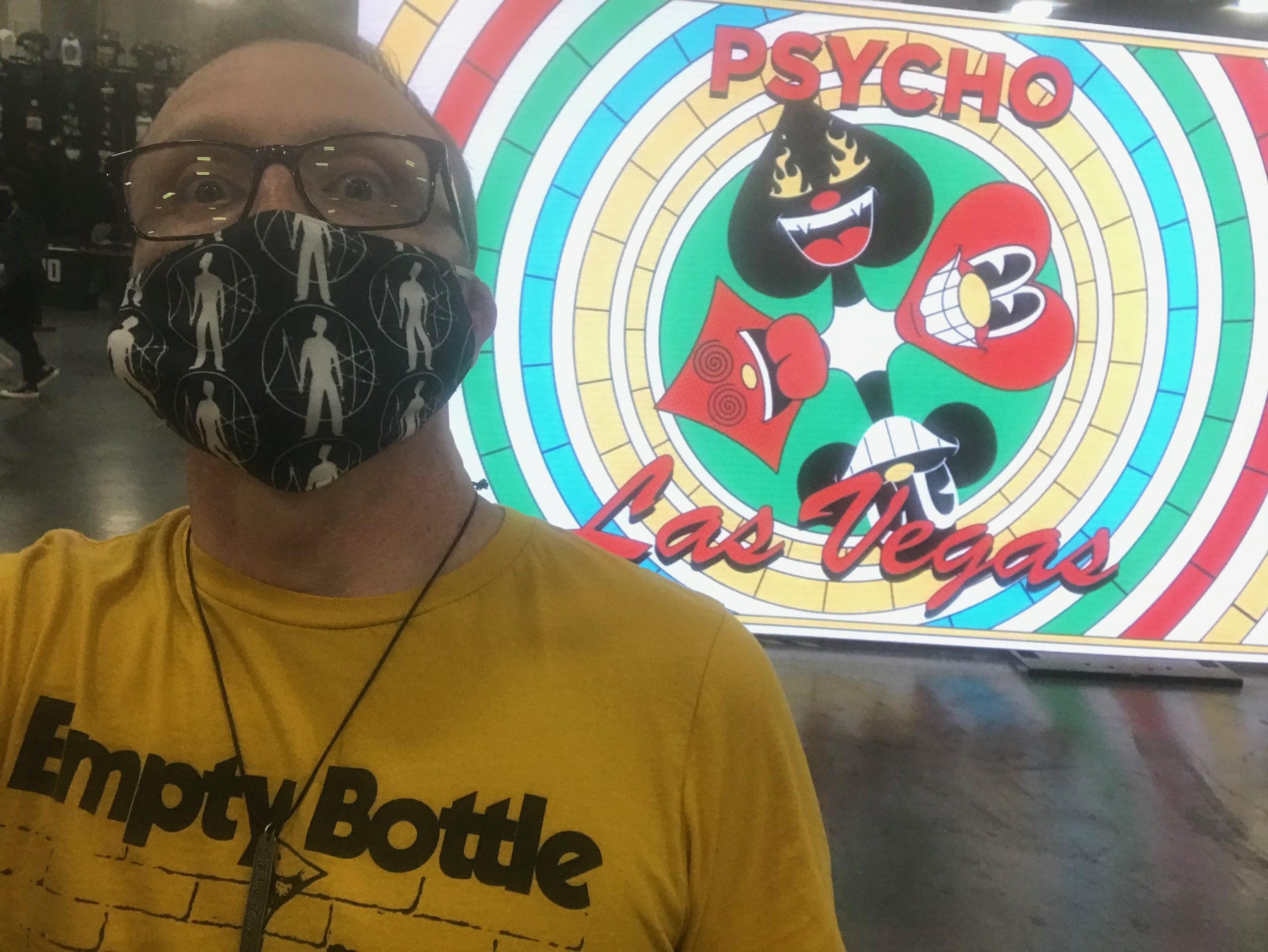
I wasn’t sure what to expect at the 2021 Psycho Las Vegasmusic festival. I’d bought tickets to the 2020 festival, but that was, like everything else, cancelled due to the pandemic. I kept the tickets in hopes that most, if not all, of the bands would return. Most did, but there were some absences that were bummers (Windhand, Mephistofeles, and Boris in particular). There were also additions that were quite welcome (Osees, Frankie and the Witch Fingers, Thievery Corporation).
I also had no idea what to expect in terms of healthy safety measures and how I, my wife, and people in general were going to react to be at a music festival again, or even in a casino and among large groups of people again. Nonetheless, we took our vaccinated bodies to Sin City and were happy to discover that the airplane, airport, and all businesses in Nevada are under a mask mandate.
My guess is that 70% of festival crowd was masked nearly all the time. The only person I heard complaining about it was Glenn Danzig (more on that later). The biggest health hazard complaint I had was due to the stunning amount of smokers. I’ve been gone from festivals for so long that I’d forgotten how many people smoke at them, let alone in casinos. Plus, marijuana is legal in Nevada, so the stank of the sticky-icky was everywhere. It’s illegal to smoke it in public, but the odds of you getting cited for it are slim to none.
The festival opened on Thursday, August 19th, with the “Psycho Swim” kick-off party. The festival is held at the Mandalay Bay Casino Hotel, and the “Psycho Swim” is at their Daylight Beach Club – where the security didn’t allow you to bring in a wallet chain or even gum. The pool was full of metal fans, psych-weirdos, music nerds, and, yes, some sexy people.
Everyone is sinking in this pool because the festival was so metal-heavy.
No, we didn’t get into the pool. It was too crowded by the time we got there, and we were mainly there to see bands for the first time in almost two years. The first was Here Lies Man, who opened the entire festival with their groovy, Afro-doom riffs.
Orange amps never fail to sound great.
For the record, I was the only one in the crowd with a Here Lies Man shirt (which I picked up from them at the last Levitation Music Festival in Austin). I got to thank many of the HLM members after the show, and J.P., the bassist, was kind enough to give me his set list.
Thanks, J.P.!
It was their first show in two years. This would be a repeated theme from nearly every band we saw over the weekend. All of them were excited to be playing a live show in front of a crowd again.
Up next were Blackwater Holylight, who started off their set by saying, “Okay, we’re going to play some depressing songs for you.” Their doom-psych was appreciated by the crowd, and their upcoming album should be pretty good – judging from the songs they played from it.
Blackwater Holylight were perhaps the only band all weekend who appropriately dressed for the desert heat.
We left for a little while to enjoy some air conditioning and lunch at an Irish pub in the shopping center that connects Mandalay Bay and the Luxor (where we stayed for about half the price of a room at Mandalay Bay). I recommend the turkey burger. We returned in time for Death Valley Girls‘ set, which was the best of the night. They played a wild set of mystical psychedelia. Lead singer Bonnie Bloomgarden, seeming to draw power from the moon, wore a red dress that made her look like a ghost from a Dario Argento movie and a belt that looked like she won it in a professional wrestling match with a cyborg from the year 2305 (and, for all I know, she did). There were a few times when I wasn’t sure if she was wiping sweat from her face or tears from being so happy that they were performing their “first show in about three hundred years,” as she put it. Guitarist Larry Schemel was on fire as well, unleashing some heavy riffs throughout the set. I chatted with him afterwards for a moment, and thanked him for coming out to the festival. He thanked me and said, “This feels weird. It’s our first show after so long…It’s bizarre.” He also gave me his set list, which was a surprise gift.
“Look at the moon!” – Bonnie Bloomgarden (in red dress) points out her cosmic guide for the evening.Thanks, Larry!
It was a good start to the weekend. We had good music, good food, everyone was being cool about each other’s health (the resorts had plenty of hand sanitizer stations and free masks), and we had plenty of time to sleep in the next day.
I did not expect my first live concert experience post-pandemic to be a show by rock legends ZZ Top, nor did I expect it to be at a county fairgrounds not even an hour’s drive from my house, but the pandemic taught us to expect the unexpected – so I should probably just shut up and get on with reviewing the fun show.
We got to the fair in plenty of time before the show. Our seats were folding chairs on the dirt track where the annual demolition derby is held, as well as other events. There’s also grandstand seating that was probably less crowded and and not muddy – as it had rained earlier that day.
It also rained again, to the point where the show had to be delayed an hour due to the deluge that hit the fair. ZZ Top, minus Dusty Hill, who was home in Texas recovering from a hip injury, took the stage “on time.” Hill was replaced on bass by one of their long-serving guitar techs, Elwood Francis, and he did a fine job. They opened with “Under Pressure,” which is even fuzzier live, rivaling Billy Gibbons‘ epic beard.
It’s sometimes easy to forget how good of a guitarist Gibbons is. He can play anything from blues to psychedelic rock to garage rock. Frank Beard still chops behind a massive drum kit that had an impressive amount of customization on it.
Another impressive thing was the production sound and quality of the show. ZZ Top has a top-notch crew. Most, if not all, of Gibbons’ guitar effects were done remotely off-stage by the crew of with this weird-looking thing on stage left.
Is it an effects pedal coyote?
The show was a “greatest hits” set that also included a fun version of Merle Travis‘ “Sixteen Tons.” The tour is their 50th anniversary tour, and “Sharp Dressed Man” and “Legs” were, of course, big hits with the crowd. I’d hoped for “TV Dinners,” but alas, it wasn’t meant to be. They did break out the monster fur guitars, however.
It was a fun night, and Dusty Hill died just a few days later. Gibbons and Beard have stated they will continue touring and making music, as it was Hill’s wish that they would.
Playing a home show still feels special for The Beths, who began playing shows in 2015 and quickly won over local audiences with a low-key approach that disguised their drive for excellence. Today, the band announces its first live recording and film, Auckland, New Zealand, 2020, out September 17th on Carpark Records. The announcement also comes on the three-year anniversary of the release of their debut album, Future Me Hates Me. Auckland, New Zealand, 2020 showcases the infectious energy The Beths bring to every performance. Native birds, wonkily crafted by the band from tissue paper and wire, festoon the venue’s cavernous ceiling while house plants soften and disguise the imposing pipes of an organ. The presence of the film crew isn’t disguised: much of the camerawork is handheld; full of fast zooms and pans. “Watching the film for the first time brought back all the emotions of 2020 for us. Sports Team have done such an amazing job of capturing the mix of anxiety and simple joy that was touring music in NZ at the time. We are so grateful that it happened and grateful to have it documented with so much love and care,” says lead vocalist/guitarist Elizabeth Stokes.
“Future Me Hates Me” is a fan favorite, as both band and audience feed off the mutual energy in the room.
After building a loyal following through live performances and their 2016 EP Warm Blood, The Beths signed to Carpark Records and released the debut album, Future Me Hates Me, in 2018. Jump Rope Gazers, released in July 2020, was a slower, yearning follow-up that still fizzes and sparks with pop-punk sensibilities. Immediately seized on by both fans and music critics as a bright spot during an otherwise dark year, Jump Rope Gazers was named Album of the Year at New Zealand’s national Aotearoa Music Awards in 2020, and secured the band awards for Best Group and Best Alternative Artist for the second year running. The releases catapulted the band straight into lengthy international tours that saw them support legends like The Pixies and Death Cab For Cutie as well as headlining increasingly large shows of their own.
Auckland, New Zealand, 2020 has its genesis in an urge to share the now-rare experience of a live show as widely as possible. The accompanying film makes the deep bond Stokes, lead guitarist Jonathan Pearce, bassist Benjamin Sinclair, and drummer Tristan Deck clearer than ever: capturing the in-jokes they share with audiences during on-stage banter, and foregrounding their mutual preoccupations with the game of cricket and New Zealand’s native birds. It’s a collective exhalation, in one of the few countries where live music is still possible. They deliberately include the date and location, because “That’s the sensational part of what we actually did,” says Pearce. In a mid-pandemic world, playing to a heaving, enraptured home crowd feels miraculous.
The band will follow up the release of Auckland, New Zealand, 2020 with a North American headline tour in 2022. “Our last North American tour was in summer of 2019, which feels like a century ago. There is no way to describe how much we have wanted to be over there playing music. Finally it is happening?! See you soon. xo,” says Liz. An artist pre-sale will begin on Wednesday, August 11 at 10am local time, with a Brooklyn Vegan pre-sale running on Thursday, August 12 at 10am local time. Tickets go on sale to the general public on Friday, August 13 at 10am local time. Tickets are available at thebeths.com. Fans can join the band’s new Patreon in the meantime.
Live Album Tracklist: 1. I’m Not Getting Excited 2. Great No One 3. Whatever 4. Mars, the God of War 5. Future Me Hates Me 6. introduction 7. Jump Rope Gazers 8. Uptown Girl
9. bird talk 10. Happy Unhappy 11. Out of Sight 12. thank you 13. Don’t Go Away 14. Little Death 15. Dying to Believe 16. River Run
Film Setlist: 1. I’m Not Getting Excited 2. Great No One 3. Whatever 4. Mars, the God of War
5. Future Me Hates Me 6. Jump Rope Gazers 7. Uptown Girl 8. Happy Unhappy 9. Out of Sight 10. Little Death 11. Dying To Believe 12. You Wouldn’t Like Me 13. River Run
Tour Dates: Fri. Sept. 17, 2021 – Auckland, NZ @ The Others Way Tue. Sept. 28, 2021 – Auckland, NZ @ Whammy Bar Wed. Sept. 29, 2021 – Auckland, NZ @ Whammy Bar Thu. Sept. 30, 2021 – Auckland, NZ @ Whammy Bar Fri. Oct. 1, 2021 – Auckland, NZ @ Whammy Bar Sat. Oct. 2, 2021 – Auckland, NZ @ Whammy Bar Fri. Oct. 22, 2021 – Tauranga, NZ @ Tauranga Arts Festival Sat. Oct. 23, 2021 – Hawke’s Bay, NZ @ Labour of Love Fri. Oct. 29, 2021 – Wellington, NZ @ San Fran Sat. Oct. 30, 2021 – Wellington, NZ @ College of Creative Arts, Massey University (AA show) Sun. Oct. 31, 2021 – Nelson, NZ @ Nelson Arts Festival Thu. Nov. 4 – Sydney, NSW @ Factory Theatre Fri. Nov. 5 – Brisbane, QLD @ The Zoo Sat. Nov. 6 – Melbourne, VIC @ The Night Cat Sat. Dec. 4 – Auckland, NZ @ The Outerfields
Thu. Jan. 20, 2022 – Washington, D.C. @ Black Cat Fri. Jan. 21, 2022 – Philadelphia, PA @ Underground Arts Sat. Jan. 22, 2022 – New York, NY @ Rough Trade (in-store signing) Sat. Jan. 22, 2022 – New York, NY @ Webster Hall Sun. Jan. 23, 2022 – Boston, MA @ The Sinclair Tue. Jan. 25, 2022 – Montreal, QC @ Bar Le Ritz Wed. Jan. 26, 2022 – Toronto, ON @ Lee’s Palace Fri. Jan. 28, 2022 – Chicago, IL @ Metro Wed. Feb. 2, 2022 – Calgary, AB @ Commonwealth Fri. Feb. 4, 2022 – Vancouver, BC @ Biltmore Cabaret Sat. Feb. 5, 2022 – Seattle, WA @ NeumosSun. Feb. 6, 2022 – Portland, OR @ Wonder Ballroom Tue. Feb. 8, 2022 – San Francisco, CA @ The Independent Thu. Feb. 10, 2022 – Los Angeles, CA @ Regent Theater Sat. Feb. 12, 2022 – Phoenix, AZ @ Valley Bar Tue. Feb. 15, 2022 – Austin, TX @ Parish Wed. Feb. 16, 2022 – Dallas, TX @ Club Dada Fri. Feb. 18, 2022 – Atlanta, GA @ Masquerade (Hall) Sat. Feb. 19, 2022 – Nashville, TN @ Mercy Lounge Sun. Mar. 27, 2022 – Southampton, UK @ The Loft Mon. Mar. 28, 2022 – Leeds, UK @ Brudenell Social Club Tue. Mar. 29, 2022 – Glasgow, UK @ St Luke’s Thu. Mar. 31, 2022 – Manchester, UK @ Club Academy Fri. Apr. 1, 2022 – Bristol, UK @ SWX Sat. Apr. 2, 2022 – Birmingham, UK @ The Castle and Falcon Mon. Apr. 4, 2022 – London, UK @ O2 Forum Kentish TownTue. Apr. 5, 2022 – Brighton, UK @ Concorde II Thu. Apr. 7, 2022 – Paris, FR @ Point Ephémère Fri. Apr. 8, 2022 – Lyon, FR @ Le Marché Gare Sat. Apr. 9, 2022 – Dudingen, CH @ Bad Bonn Sun. Apr. 10, 2022 – Lausanne, CH @ Le Romandie Tue. Apr. 12, 2022 – Milan, IT @ Biko Wed. Apr. 13, 2022 – Munich, DE @ Feierwerk Fri. Apr. 15, 2022 – Vienna, AT @ B72 Sat. Apr. 16, 2022 – Prague, CZ @ Underdogs’ Mon. Apr. 18, 2022 – Berlin, DE @ LidoTue. Apr. 19, 2022 – Copenhagen, DK @ VEGA Ideal Bar Wed. Apr. 20, 2022 – Hamburg, DE @ Molotow Thu. Apr. 21, 2022 – Cologne, DE @ Bumann & Sohn Fri. Apr. 22, 2022 – Brussels, BE @ Ancienne Belgique Sat. Apr. 23, 2022 – Amsterdam, NL @ Paradiso Sun. Apr. 24, 2022 – Esch-sur-Alzette, LU @ Kulturfabrik
Today, Sam Evian announces his new album, Time to Melt, out October 29th on Fat Possum, and presents a new single/video, “Knock Knock.” Additionally, he announces a fall 2021 Northeast tour. Following a brief decampment to upstate New York to create his last album, You, Forever, Sam realized he could no longer resist the urge to escape the anxious city life. He and his partner, Hannah Cohen, split, building their refuge and Sam’s studio, Flying Cloud Recordings, in the quiet of a Catskills town. That reflective, relaxing environment inexorably shaped Time to Melt, a glowing set of soulfully psychedelic pop gems and a testimonial to the life and wisdom to be found when you give yourself the mercy of space.
During the last decade, Sam has become a preeminent collaborator, producing and engineering records for the likes of Big Thief, Cass McCombs, Cassandra Jenkins and Widowspeak. In their new home, he and Hannah hosted bands like house guests as he helmed their sessions. The coronavirus, though, clamped down on those interactions, largely sealing the couple from their longtime scene. So Sam tried something new: He sorted through more than 60 instrumental demos he’d recorded in the last two years and began shaping the most enticing of them into songs with help from Hannah and long-distance friends—Spencer Tweedy, Chris Bear, Jon Natchez (The War On Drugs), even strangers who sent him voice memos via Instagram. He took the unexpected time at home to dig deeper than ever before into his world of sounds and ideas, calmly considering our moment of prevailing chaos through a lens of newfound distance.
Time to Melt reckons with the weight of our time, even when it sounds largely weightless. New single “Knock Knock” taps Sam’s memories of race-and-class violence in the small-town South where he was raised and his subsequent reckoning with our crumbling American façade. The track, finished in June of 2020 as protests unfolded across the country, is a tribute to the perseverance of the vulnerable, who find community and joy in spite of the way centuries of miscreants try to deny it. “’Knock Knock’ is a song of commiseration,” says Sam. “It’s a conversation with my sibling, and really anyone else with a conscience. We talk a lot about the small town in Eastern North Carolina where we grew up, and why we left. Growing up we saw a lot of racism, violence, poverty, disparity, ignorance…all of it not so hidden under a veil of southern hospitality and dogmatic beliefs. A year later after George Floyd’s murder, I hope we can keep the conversation going. The veil is lifted for all to see. Knock knock – who’s there? A broken America.”
The song’s cinematic, light-hearted video, created by Josh Goleman and filmed in the almost completely abandoned town of Meltsville, New York, brings the Time To Melt album art to life.
Time to Melt is an album of sounds so pleasant and compelling that you put it on and follow the slipstream. There are songs of celebration on Time to Melt, paeans to whatever joy it is we find in life or love, such as the previously released “Easy to Love,” an ode to finding a new paradise outside of the city where you can plant love and literally watch it bloom. The album’s intoxicating rhythms and timbral webs are as settling, even seductive as an evening glass of wine. But whatever your day’s end ritual may be, it isn’t some idle exercise. It’s a place to unpack the pain and wonder, the suffering and promise of the moment, to reflect on where you have been and what might come next. In 40 striking minutes, Time to Melt sorts through a year of a life spent in rage and hope, lockdown and love.
The Sam Evian band will tour the Northeast this fall in support of Time to Melt. Sam (guitar, vocals) will be joined by Brian Betancourt (bass), Michael Coleman (keys), Sean Mullins (drums), and Liam Kazar (guitar, synths). Tickets are on sale this Friday, August 13th at 10am EST. Watch the “Easy To Love” Video
Time to Melt Tracklist 1. Freezee Pops 2. Dream Free (feat. Hannah Cohen) 3. Time To Melt 4. Knock Knock 5. Arnolds Place 6. Sunshine 7. Never Know 8. Lonely Days 9. Easy To Love 10. 999 Free 11. Around It Goes
Sam Evian Tour Dates Fri. Oct. 29 – Hamden, CT @ Space Ballroom Sat. Oct. 30 – Woodstock, NY @ The Colony Wed. Nov. 3 – New York, NY @ Bowery Ballroom Thu. Nov. 4 – Boston, MA @ The Sinclair Fri. Nov. 5 – Asbury Park, NJ @ The Saint Sat. Nov. 6 – Washington, DC @ DC9 Wed. Nov. 10 – Philadelphia, PA @ Johnny Brendas Thu. Nov. 11 – Holyoke, MA @ Gateway City Arts Fri. Nov. 12 – Providence, RI @ Columbus Theatre Sat. Nov. 13 – Portland, ME @ Space Gallery Fri. Nov. 19 – Amagansett, NY @ Stephen Talkhouse Sat. Nov. 20 – Troy, NY @ The Hangar